BEFORE YOU READ · 1 MIN 35 SEC
Watch: Sea Turtles Under Threat
Build background knowledge and hear the key vocabulary before reading. Real footage and illustrated examples show why turtles need a clear path to the ocean and how a turtle excluder device works.
Narrated by Kendra Simms, founder of Flow & Fidelity Consulting. Vocabulary is highlighted in yellow; captions and source credits are included in the video.
Read the video transcript
Imagine being a tiny sea turtle, just hatched from an egg. Your habitat, or where you live, includes the beach and ocean. Your first challenge is reaching the water.
At night, the brighter horizon over the ocean is a cue, a signal that helps hatchlings find their way. Bright buildings can create a barrier, something that gets in the way. Hatchlings that head inland become vulnerable, or at risk of harm.
One solution is to turn off unnecessary lights or shield them so they shine away from the beach.
Farther offshore, a turtle might swim into a shrimp net. A turtle excluder device has a slanted grid, a set of bars with gaps, or spaces, between them. Shrimp pass through those spaces while larger turtles are guided toward an escape opening.
Researchers tested narrower gaps of two and a half inches instead of about four inches. Their final tests show fewer young turtles were accidentally captured, without a significant drop in the shrimp catch.
Both solutions help turtles get past barriers. As you read, look for the evidence that explains how each solution works.
YOUR TEACHING WEEK
Teach one day at a time.
Click a day to open only the materials for that session. Use the full packet or the quick page selector whenever needed.
Start HereShared materialsPreview the photo, read the student passage, prepare with the teacher-annotated passage and support guide.
Photo preview · Page 1
Read selectable page text
FLOW & FIDELITY / READING INTERVENTION


START HERE • PHOTO PREVIEW


Look Closely Before You Read
Sea Turtles Under Threat / Four 30-minute lessons + optional Day 5


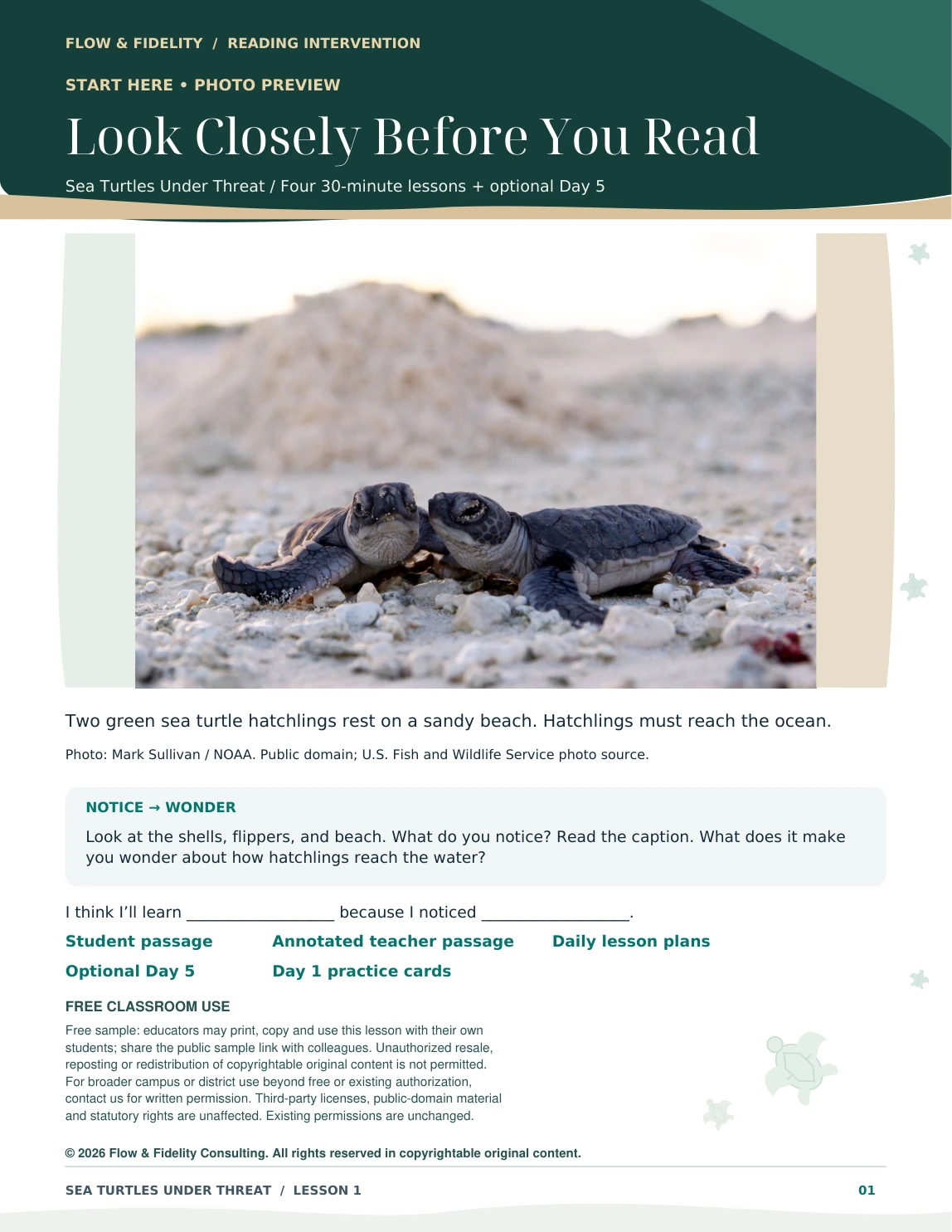
Two green sea turtle hatchlings rest on a sandy beach. Hatchlings must reach the ocean.
Photo: Mark Sullivan / NOAA. Public domain; U.S. Fish and Wildlife Service photo source.


   NOTICE → WONDER

   Look at the shells, flippers, and beach. What do you notice? Read the caption. What does it make
   you wonder about how hatchlings reach the water?


I think I’ll learn ___________________ because I noticed ___________________.
Student passage                Annotated teacher passage                 Daily lesson plans
Optional Day 5                 Day 1 practice cards


SEA TURTLES UNDER THREAT / LESSON 1                                                                   01

FREE CLASSROOM USE
Free sample: educators may print, copy and use this lesson with their own
students; share the public sample link with colleagues. Unauthorized resale,
reposting or redistribution of copyrightable original content is not permitted.
For broader campus or district use beyond free or existing authorization,
contact us for written permission. Third-party licenses, public-domain material
and statutory rights are unaffected. Existing permissions are unchanged.

© 2026 Flow & Fidelity Consulting. All rights reserved in copyrightable original content.
Student passage, part 1 · Page 2
Read selectable page text
FLOW & FIDELITY / READING INTERVENTION

STUDENT PASSAGE • PART 1 OF 2


Sea Turtles Under Threat
Original informational text


Name: __________________________________ Date: __________________


     WHILE YOU READ

     Find what normally helps hatchlings reach the ocean. What can get in their way?


01      On a nesting beach, a newly hatched sea turtle has one urgent task: reach the
        water. Offshore, a young turtle that enters a shrimp net faces a different
        problem: get out before the net is hauled in. To survive, turtles must move
        through different parts of their habitat, and human activity can block their path
        in more than one place. Protecting turtles begins with noticing precisely where
        the path breaks down.

A Darker Path to the Sea
02      Hatchlings often emerge after dark. On a beach without strong artificial lighting,
        the seaward horizon is typically brighter and more open than the land behind
        them. That difference helps guide the turtles toward the ocean. A bright light
        from a building can compete with that cue. Hatchlings may mistake that light for
        a natural cue and head inland instead of toward the water. The longer they
        remain on the beach, the more vulnerable they are to drying out or being caught
        by predators.

03      People can reduce that risk without closing the beach. Turning off unnecessary
        lights, shielding fixtures, or aiming lights away from the sand keeps fewer lights
        visible from the nest. A shield changes where the light falls. For example, a
        covered lamp can direct light down toward a walkway instead of out across the
        nesting sand. Those changes do not move hatchlings by hand. Instead, they help
        restore conditions that allow hatchlings to find the ocean for themselves. That
        distinction matters: the goal is to remove interference, not replace the turtles’
        own navigation.


SEA TURTLES UNDER THREAT / LESSON 1                                                    02

© 2026 Flow & Fidelity Consulting. All rights reserved in copyrightable original content.
Student passage, part 2 · Page 3
Read selectable page text
FLOW & FIDELITY / READING INTERVENTION

STUDENT PASSAGE • PART 2 OF 2


Sea Turtles Under Threat
Original informational text


An Exit Inside a Fishing Net
04   Farther from shore, shrimp crews pull large nets through the water. A turtle can
     enter a net along with shrimp. A turtle excluder device, or TED, is a slanted grid
     of bars fitted inside the net. Shrimp pass through the gaps into the back of the
     net. A turtle too wide to fit between the bars is guided toward an escape
     opening. The grid works by sending animals of different sizes in different
     directions.

05   But a design that works for a large turtle may not work for a smaller one. In the
     northern Gulf, observers found that some young turtles could pass between the
     bars and end up behind the grid. Once there, they might not have enough
     strength to swim back out. To address the problem, researchers worked with
     shrimp crews to test grids with narrower gaps. In a traditional grid, the bars are
     about four inches apart. Researchers tested gaps of two and a half inches. These
     measurements describe the space between the bars, not the size of the escape
     opening. The gaps had to be small enough to guide more young turtles toward
     the exit but large enough for shrimp to pass.

06   In the project’s final tests, the modified grids reduced the accidental capture of
     young turtles without a significant drop in the shrimp catch. The result illustrates
     why measuring both outcomes was important. If the team had tracked only
     turtles, it would not have known whether the new grid allowed the crews to keep
     catching shrimp as intended.

07   The solutions at the beach and in the net work differently. One makes a natural
     cue easier to follow. The other changes the route a turtle can take inside fishing
     gear. In each case, progress starts by identifying the specific barrier and
     choosing a change that helps the turtle get past it.


SEA TURTLES UNDER THREAT / LESSON 1                                                   03

© 2026 Flow & Fidelity Consulting. All rights reserved in copyrightable original content.
Teacher annotated passage, part 1 · Page 4
Read selectable page text
FLOW & FIDELITY / READING INTERVENTION

 TEACHER ANNOTATED PASSAGE • PART 1 OF 2


Sea Turtles Under Threat
Original informational text


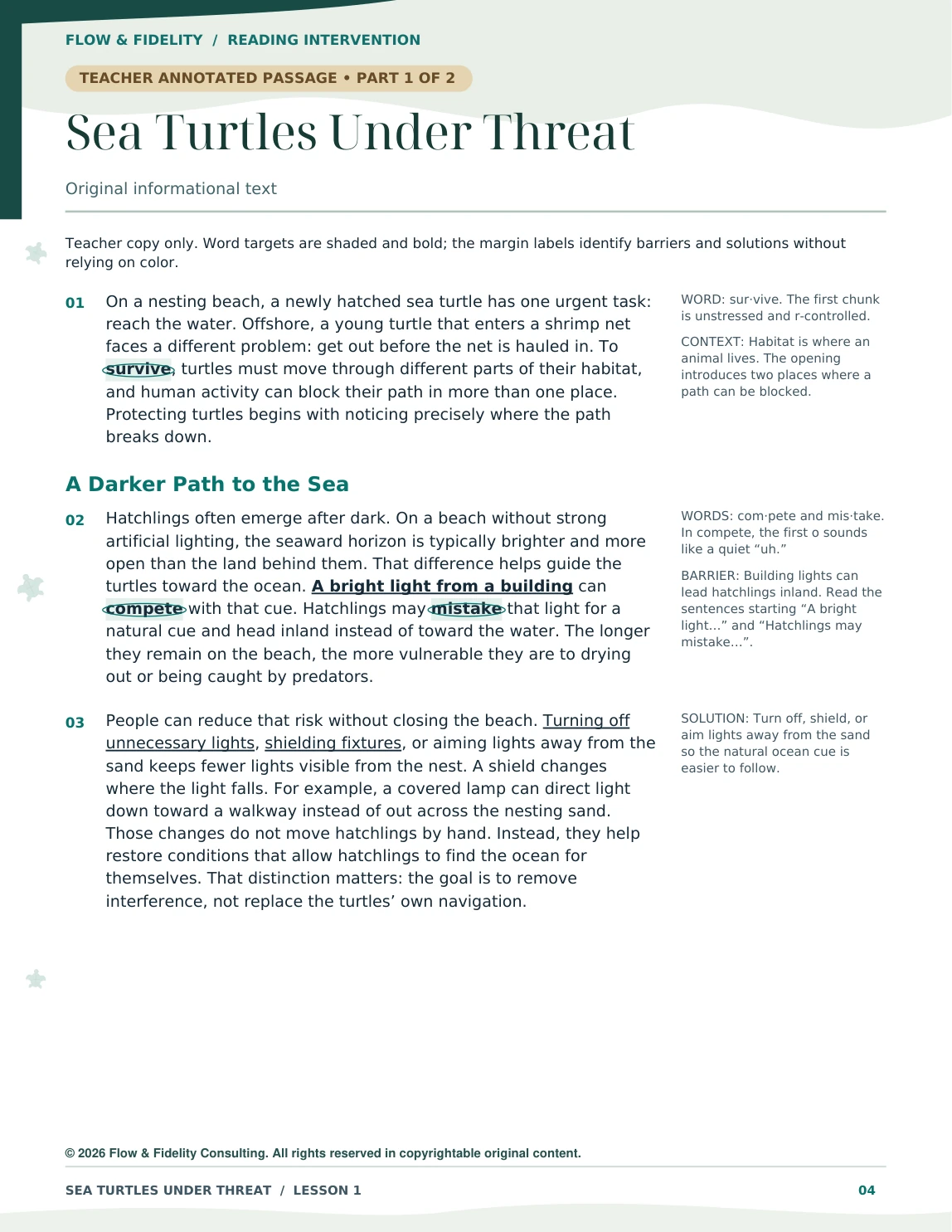
Teacher copy only. Word targets are shaded and bold; the margin labels identify barriers and solutions without
relying on color.

01   On a nesting beach, a newly hatched sea turtle has one urgent task:              WORD: sur·vive. The first chunk
                                                                                      is unstressed and r-controlled.
     reach the water. Offshore, a young turtle that enters a shrimp net
     faces a different problem: get out before the net is hauled in. To               CONTEXT: Habitat is where an
                                                                                      animal lives. The opening
     survive, turtles must move through different parts of their habitat,             introduces two places where a
     and human activity can block their path in more than one place.                  path can be blocked.
     Protecting turtles begins with noticing precisely where the path
     breaks down.


A Darker Path to the Sea
02   Hatchlings often emerge after dark. On a beach without strong                    WORDS: com·pete and mis·take.
                                                                                      In compete, the first o sounds
     artificial lighting, the seaward horizon is typically brighter and more          like a quiet “uh.”
     open than the land behind them. That difference helps guide the
                                                                                      BARRIER: Building lights can
     turtles toward the ocean. A bright light from a building can                     lead hatchlings inland. Read the
     compete with that cue. Hatchlings may mistake that light for a                   sentences starting “A bright
                                                                                      light…” and “Hatchlings may
     natural cue and head inland instead of toward the water. The longer
                                                                                      mistake…”.
     they remain on the beach, the more vulnerable they are to drying
     out or being caught by predators.

03   People can reduce that risk without closing the beach. Turning off               SOLUTION: Turn off, shield, or
                                                                                      aim lights away from the sand
     unnecessary lights, shielding fixtures, or aiming lights away from the           so the natural ocean cue is
     sand keeps fewer lights visible from the nest. A shield changes                  easier to follow.
     where the light falls. For example, a covered lamp can direct light
     down toward a walkway instead of out across the nesting sand.
     Those changes do not move hatchlings by hand. Instead, they help
     restore conditions that allow hatchlings to find the ocean for
     themselves. That distinction matters: the goal is to remove
     interference, not replace the turtles’ own navigation.


SEA TURTLES UNDER THREAT / LESSON 1                                                                               04

© 2026 Flow & Fidelity Consulting. All rights reserved in copyrightable original content.
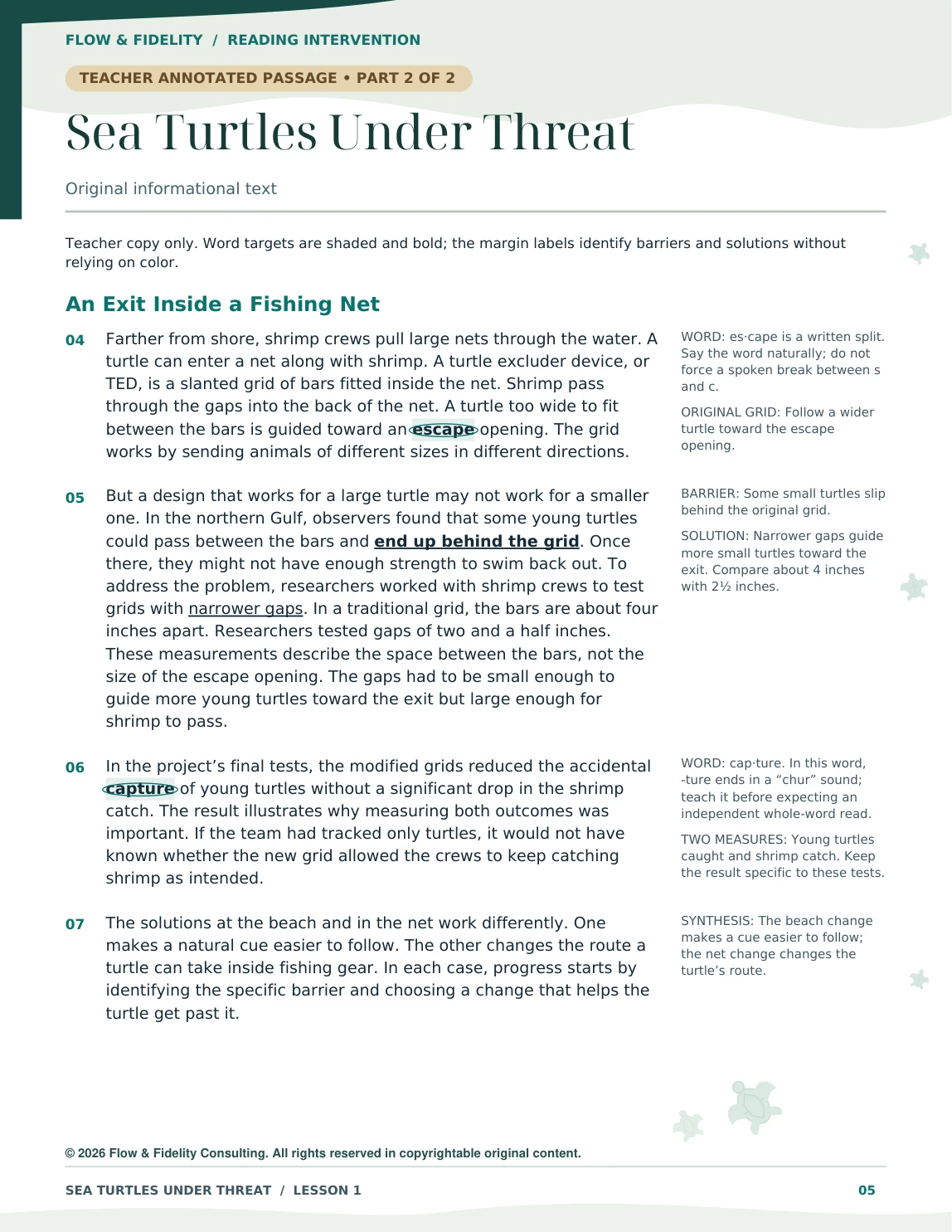
Teacher annotated passage, part 2 · Page 5
Read selectable page text
FLOW & FIDELITY / READING INTERVENTION

 TEACHER ANNOTATED PASSAGE • PART 2 OF 2


Sea Turtles Under Threat
Original informational text


Teacher copy only. Word targets are shaded and bold; the margin labels identify barriers and solutions without
relying on color.


An Exit Inside a Fishing Net
04   Farther from shore, shrimp crews pull large nets through the water. A            WORD: es·cape is a written split.
                                                                                      Say the word naturally; do not
     turtle can enter a net along with shrimp. A turtle excluder device, or           force a spoken break between s
     TED, is a slanted grid of bars fitted inside the net. Shrimp pass                and c.
     through the gaps into the back of the net. A turtle too wide to fit              ORIGINAL GRID: Follow a wider
     between the bars is guided toward an escape opening. The grid                    turtle toward the escape
                                                                                      opening.
     works by sending animals of different sizes in different directions.

05   But a design that works for a large turtle may not work for a smaller            BARRIER: Some small turtles slip
                                                                                      behind the original grid.
     one. In the northern Gulf, observers found that some young turtles
     could pass between the bars and end up behind the grid. Once                     SOLUTION: Narrower gaps guide
                                                                                      more small turtles toward the
     there, they might not have enough strength to swim back out. To                  exit. Compare about 4 inches
     address the problem, researchers worked with shrimp crews to test                with 2½ inches.
     grids with narrower gaps. In a traditional grid, the bars are about four
     inches apart. Researchers tested gaps of two and a half inches.
     These measurements describe the space between the bars, not the
     size of the escape opening. The gaps had to be small enough to
     guide more young turtles toward the exit but large enough for
     shrimp to pass.

06   In the project’s final tests, the modified grids reduced the accidental          WORD: cap·ture. In this word,
                                                                                      -ture ends in a “chur” sound;
     capture of young turtles without a significant drop in the shrimp                teach it before expecting an
     catch. The result illustrates why measuring both outcomes was                    independent whole-word read.
     important. If the team had tracked only turtles, it would not have               TWO MEASURES: Young turtles
     known whether the new grid allowed the crews to keep catching                    caught and shrimp catch. Keep
                                                                                      the result specific to these tests.
     shrimp as intended.

07   The solutions at the beach and in the net work differently. One                  SYNTHESIS: The beach change
                                                                                      makes a cue easier to follow;
     makes a natural cue easier to follow. The other changes the route a              the net change changes the
     turtle can take inside fishing gear. In each case, progress starts by            turtle’s route.
     identifying the specific barrier and choosing a change that helps the
     turtle get past it.


SEA TURTLES UNDER THREAT / LESSON 1                                                                                 05

© 2026 Flow & Fidelity Consulting. All rights reserved in copyrightable original content.
Teacher glossary and supports · Page 16
Read selectable page text
FLOW & FIDELITY / READING INTERVENTION

 TEACHER REFERENCE


Quick Glossary & Supports
Use the support that removes a barrier without doing the thinking for the student.


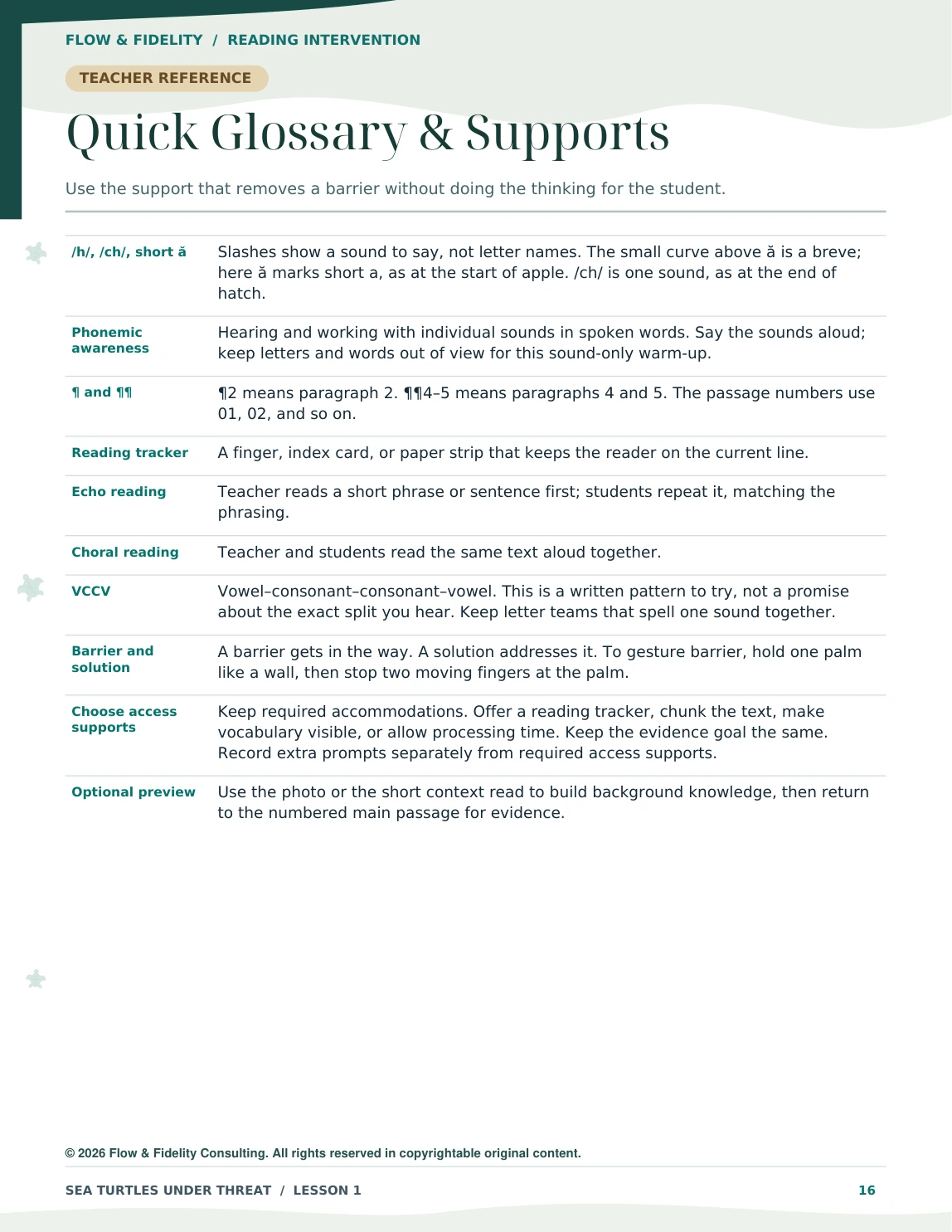
/h/, /ch/, short ă   Slashes show a sound to say, not letter names. The small curve above ă is a breve;
                     here ă marks short a, as at the start of apple. /ch/ is one sound, as at the end of
                     hatch.

Phonemic             Hearing and working with individual sounds in spoken words. Say the sounds aloud;
awareness            keep letters and words out of view for this sound-only warm-up.

¶ and ¶¶             ¶2 means paragraph 2. ¶¶4–5 means paragraphs 4 and 5. The passage numbers use
                     01, 02, and so on.

Reading tracker      A finger, index card, or paper strip that keeps the reader on the current line.

Echo reading         Teacher reads a short phrase or sentence first; students repeat it, matching the
                     phrasing.

Choral reading       Teacher and students read the same text aloud together.

VCCV                 Vowel–consonant–consonant–vowel. This is a written pattern to try, not a promise
                     about the exact split you hear. Keep letter teams that spell one sound together.

Barrier and          A barrier gets in the way. A solution addresses it. To gesture barrier, hold one palm
solution             like a wall, then stop two moving fingers at the palm.

Choose access        Keep required accommodations. Offer a reading tracker, chunk the text, make
supports             vocabulary visible, or allow processing time. Keep the evidence goal the same.
                     Record extra prompts separately from required access supports.

Optional preview     Use the photo or the short context read to build background knowledge, then return
                     to the numbered main passage for evidence.


SEA TURTLES UNDER THREAT / LESSON 1                                                                      16

© 2026 Flow & Fidelity Consulting. All rights reserved in copyrightable original content.
Optional quick context read · Page 18
Read selectable page text
FLOW & FIDELITY / READING INTERVENTION

STUDENT HANDOUT • OPTIONAL


Quick Context Read
Use this to build background knowledge; return to the main passage for evidence.


Name: __________________________________ Date: __________________


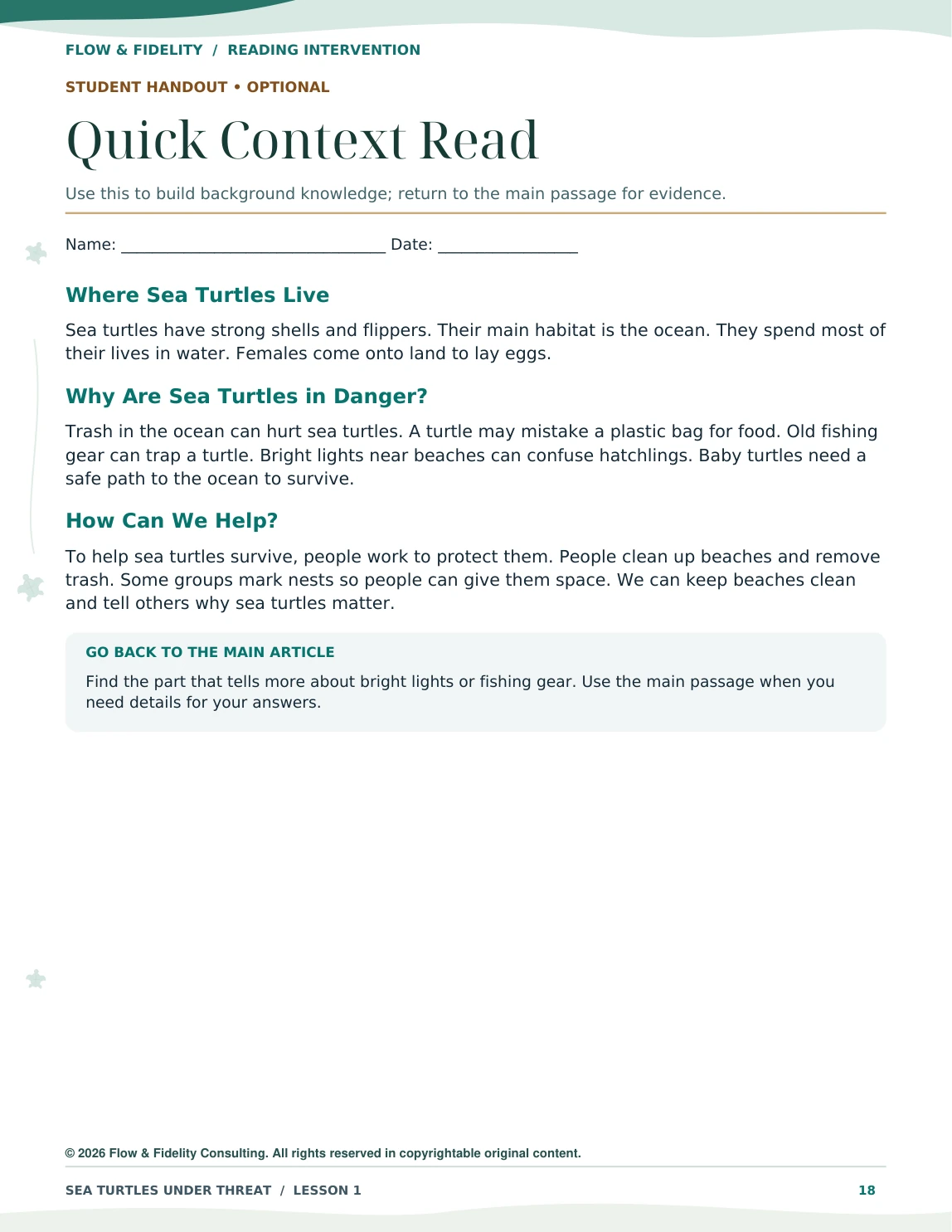
Where Sea Turtles Live
Sea turtles have strong shells and flippers. Their main habitat is the ocean. They spend most of
their lives in water. Females come onto land to lay eggs.

Why Are Sea Turtles in Danger?
Trash in the ocean can hurt sea turtles. A turtle may mistake a plastic bag for food. Old fishing
gear can trap a turtle. Bright lights near beaches can confuse hatchlings. Baby turtles need a
safe path to the ocean to survive.

How Can We Help?
To help sea turtles survive, people work to protect them. People clean up beaches and remove
trash. Some groups mark nests so people can give them space. We can keep beaches clean
and tell others why sea turtles matter.

  GO BACK TO THE MAIN ARTICLE

  Find the part that tells more about bright lights or fishing gear. Use the main passage when you
  need details for your answers.


SEA TURTLES UNDER THREAT / LESSON 1                                                                  18

© 2026 Flow & Fidelity Consulting. All rights reserved in copyrightable original content.
Teacher evidence guide · Page 22
Read selectable page text
FLOW & FIDELITY / READING INTERVENTION

 TEACHER EVIDENCE GUIDE


What a Strong Answer Shows
Teacher-only • Use the model to recognize reasoning, not to require exact phrasing.


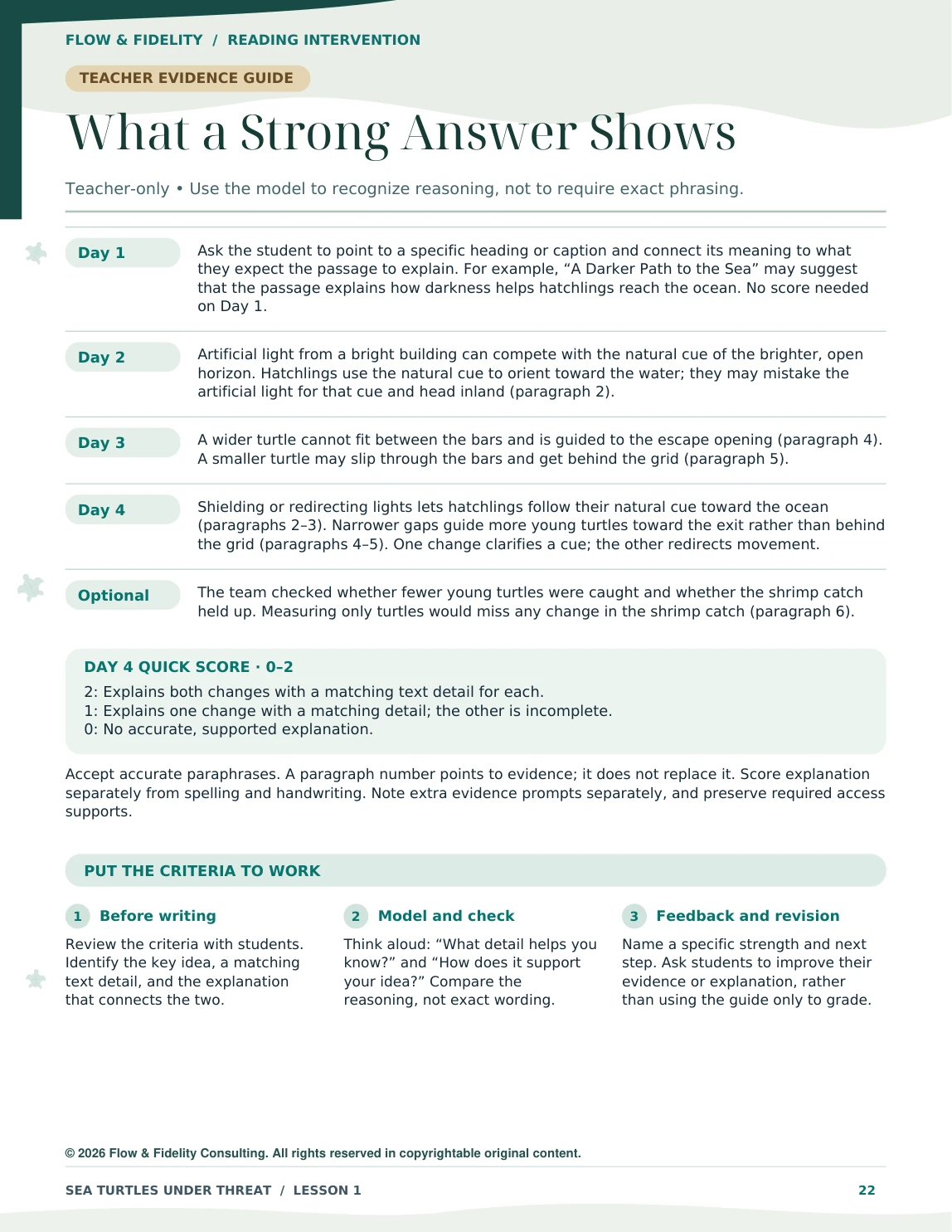
 Day 1              Ask the student to point to a specific heading or caption and connect its meaning to what
                    they expect the passage to explain. For example, “A Darker Path to the Sea” may suggest
                    that the passage explains how darkness helps hatchlings reach the ocean. No score needed
                    on Day 1.


 Day 2              Artificial light from a bright building can compete with the natural cue of the brighter, open
                    horizon. Hatchlings use the natural cue to orient toward the water; they may mistake the
                    artificial light for that cue and head inland (paragraph 2).


 Day 3              A wider turtle cannot fit between the bars and is guided to the escape opening (paragraph 4).
                    A smaller turtle may slip through the bars and get behind the grid (paragraph 5).


 Day 4              Shielding or redirecting lights lets hatchlings follow their natural cue toward the ocean
                    (paragraphs 2–3). Narrower gaps guide more young turtles toward the exit rather than behind
                    the grid (paragraphs 4–5). One change clarifies a cue; the other redirects movement.


 Optional           The team checked whether fewer young turtles were caught and whether the shrimp catch
                    held up. Measuring only turtles would miss any change in the shrimp catch (paragraph 6).


     DAY 4 QUICK SCORE · 0–2
     2: Explains both changes with a matching text detail for each.
     1: Explains one change with a matching detail; the other is incomplete.
     0: No accurate, supported explanation.


Accept accurate paraphrases. A paragraph number points to evidence; it does not replace it. Score explanation
separately from spelling and handwriting. Note extra evidence prompts separately, and preserve required access
supports.


     PUT THE CRITERIA TO WORK


 1     Before writing                    2   Model and check                     3   Feedback and revision
Review the criteria with students.      Think aloud: “What detail helps you    Name a specific strength and next
Identify the key idea, a matching       know?” and “How does it support        step. Ask students to improve their
text detail, and the explanation        your idea?” Compare the                evidence or explanation, rather
that connects the two.                  reasoning, not exact wording.          than using the guide only to grade.


SEA TURTLES UNDER THREAT / LESSON 1                                                                              22

© 2026 Flow & Fidelity Consulting. All rights reserved in copyrightable original content.
Day 1 · MondayDecode and Preview30 minutes · Phonemic awareness, decoding, word meaning and prediction.
Shared materials: Student passage · Teacher annotated passage
Teacher plan · Page 6
Read selectable page text
FLOW & FIDELITY / READING INTERVENTION

 TEACHER PLAN • DAY 1


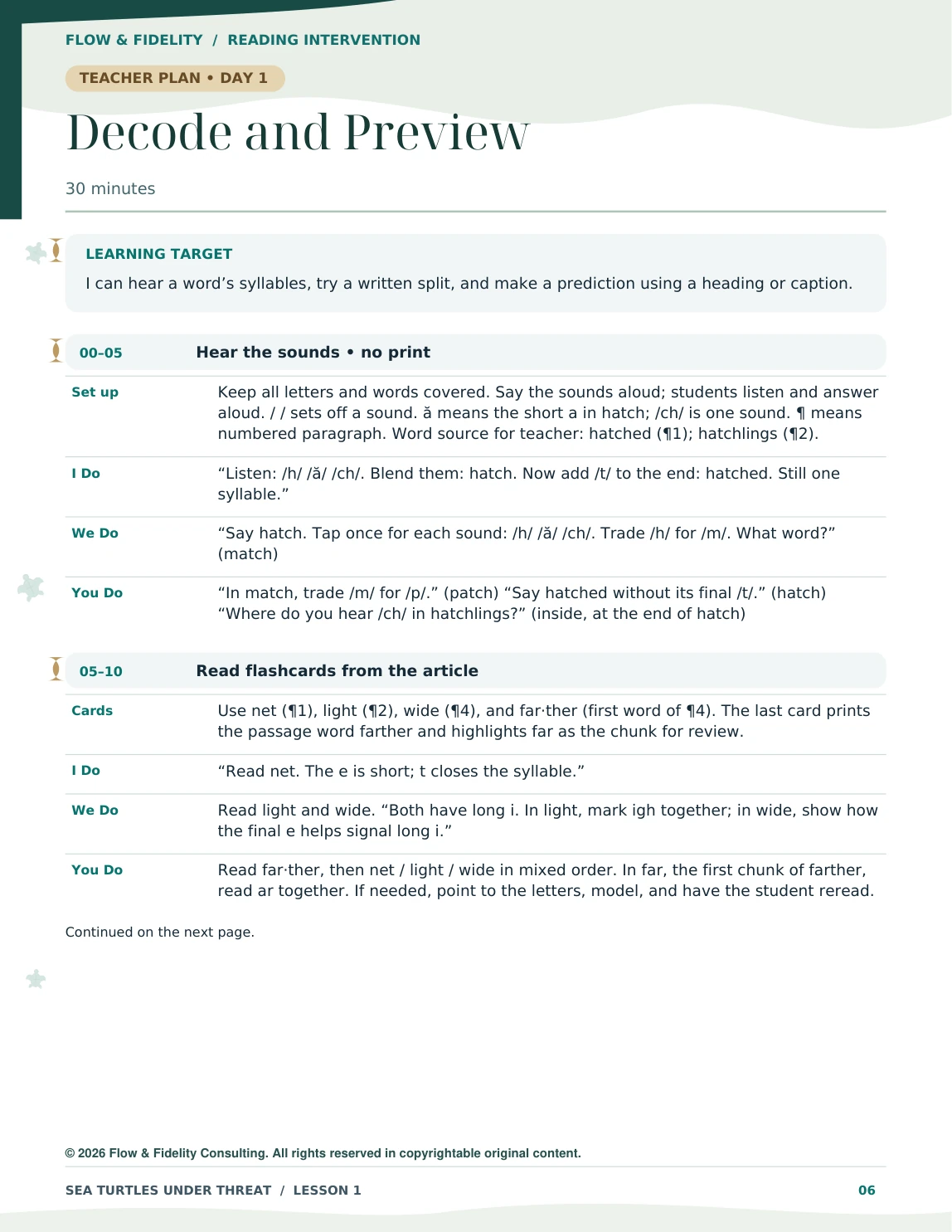
Decode and Preview
30 minutes


  LEARNING TARGET

  I can hear a word’s syllables, try a written split, and make a prediction using a heading or caption.


 00–05            Hear the sounds • no print

Set up               Keep all letters and words covered. Say the sounds aloud; students listen and answer
                     aloud. / / sets off a sound. ă means the short a in hatch; /ch/ is one sound. ¶ means
                     numbered paragraph. Word source for teacher: hatched (¶1); hatchlings (¶2).

I Do                 “Listen: /h/ /ă/ /ch/. Blend them: hatch. Now add /t/ to the end: hatched. Still one
                     syllable.”

We Do                “Say hatch. Tap once for each sound: /h/ /ă/ /ch/. Trade /h/ for /m/. What word?”
                     (match)

You Do               “In match, trade /m/ for /p/.” (patch) “Say hatched without its final /t/.” (hatch)
                     “Where do you hear /ch/ in hatchlings?” (inside, at the end of hatch)


 05–10            Read flashcards from the article

Cards                Use net (¶1), light (¶2), wide (¶4), and far·ther (first word of ¶4). The last card prints
                     the passage word farther and highlights far as the chunk for review.

I Do                 “Read net. The e is short; t closes the syllable.”

We Do                Read light and wide. “Both have long i. In light, mark igh together; in wide, show how
                     the final e helps signal long i.”

You Do               Read far·ther, then net / light / wide in mixed order. In far, the first chunk of farther,
                     read ar together. If needed, point to the letters, model, and have the student reread.

Continued on the next page.


SEA TURTLES UNDER THREAT / LESSON 1                                                                          06

© 2026 Flow & Fidelity Consulting. All rights reserved in copyrightable original content.
Teacher plan continued · Page 7
Read selectable page text
FLOW & FIDELITY / READING INTERVENTION

 TEACHER PLAN • DAY 1 CONTINUED


Decode and Preview
Keep the clean passage and the teacher copy open to the same paragraph.


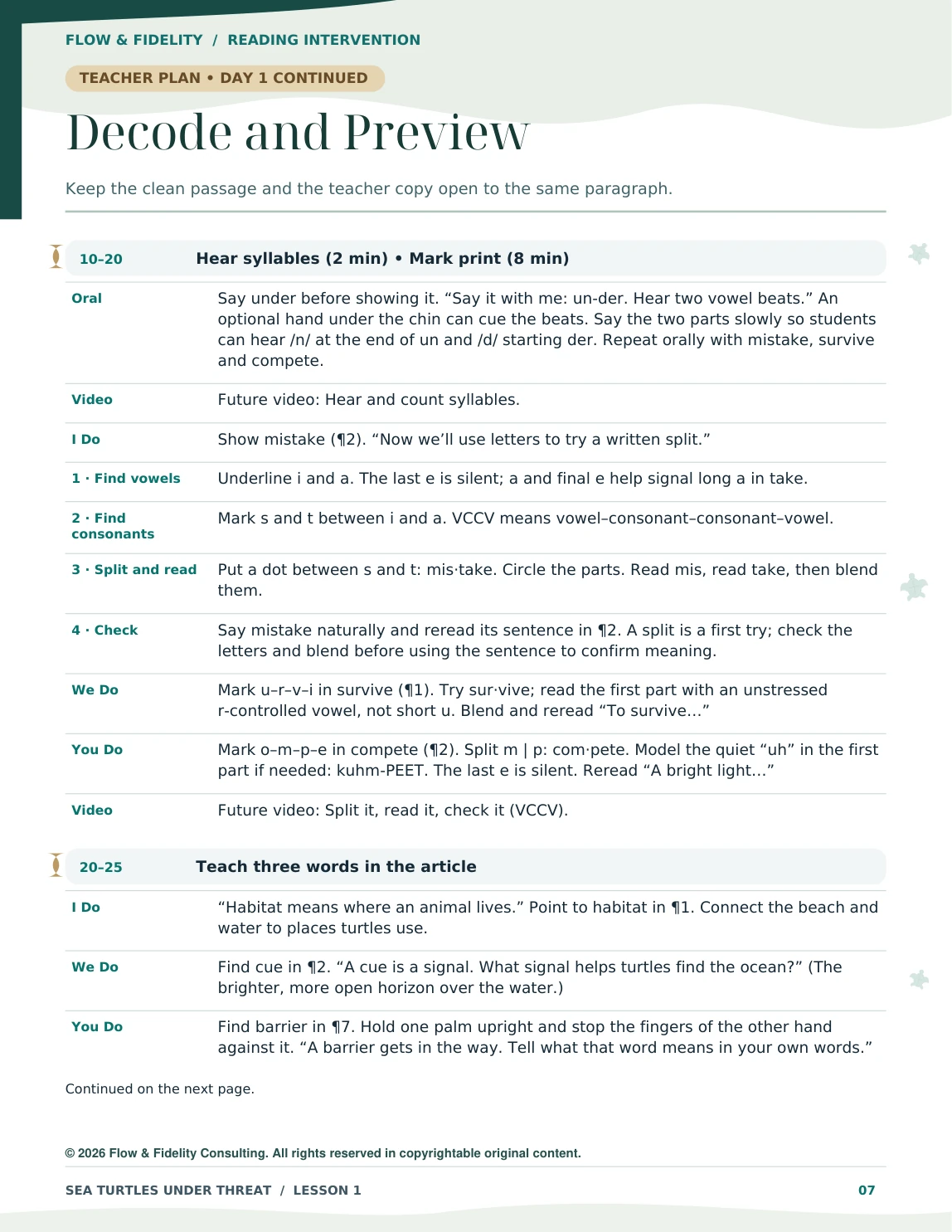
 10–20            Hear syllables (2 min) • Mark print (8 min)

Oral                 Say under before showing it. “Say it with me: un-der. Hear two vowel beats.” An
                     optional hand under the chin can cue the beats. Say the two parts slowly so students
                     can hear /n/ at the end of un and /d/ starting der. Repeat orally with mistake, survive
                     and compete.

Video                Future video: Hear and count syllables.

I Do                 Show mistake (¶2). “Now we’ll use letters to try a written split.”

1 · Find vowels      Underline i and a. The last e is silent; a and final e help signal long a in take.

2 · Find             Mark s and t between i and a. VCCV means vowel–consonant–consonant–vowel.
consonants

3 · Split and read   Put a dot between s and t: mis·take. Circle the parts. Read mis, read take, then blend
                     them.

4 · Check            Say mistake naturally and reread its sentence in ¶2. A split is a first try; check the
                     letters and blend before using the sentence to confirm meaning.

We Do                Mark u–r–v–i in survive (¶1). Try sur·vive; read the first part with an unstressed
                     r-controlled vowel, not short u. Blend and reread “To survive…”

You Do               Mark o–m–p–e in compete (¶2). Split m | p: com·pete. Model the quiet “uh” in the first
                     part if needed: kuhm-PEET. The last e is silent. Reread “A bright light…”

Video                Future video: Split it, read it, check it (VCCV).


 20–25            Teach three words in the article

I Do                 “Habitat means where an animal lives.” Point to habitat in ¶1. Connect the beach and
                     water to places turtles use.

We Do                Find cue in ¶2. “A cue is a signal. What signal helps turtles find the ocean?” (The
                     brighter, more open horizon over the water.)

You Do               Find barrier in ¶7. Hold one palm upright and stop the fingers of the other hand
                     against it. “A barrier gets in the way. Tell what that word means in your own words.”

Continued on the next page.


SEA TURTLES UNDER THREAT / LESSON 1                                                                           07

© 2026 Flow & Fidelity Consulting. All rights reserved in copyrightable original content.
Teacher plan continued · Page 8
Read selectable page text
FLOW & FIDELITY / READING INTERVENTION

 TEACHER PLAN • DAY 1 CONTINUED


Decode and Preview
Keep the clean passage and the teacher copy open to the same paragraph.


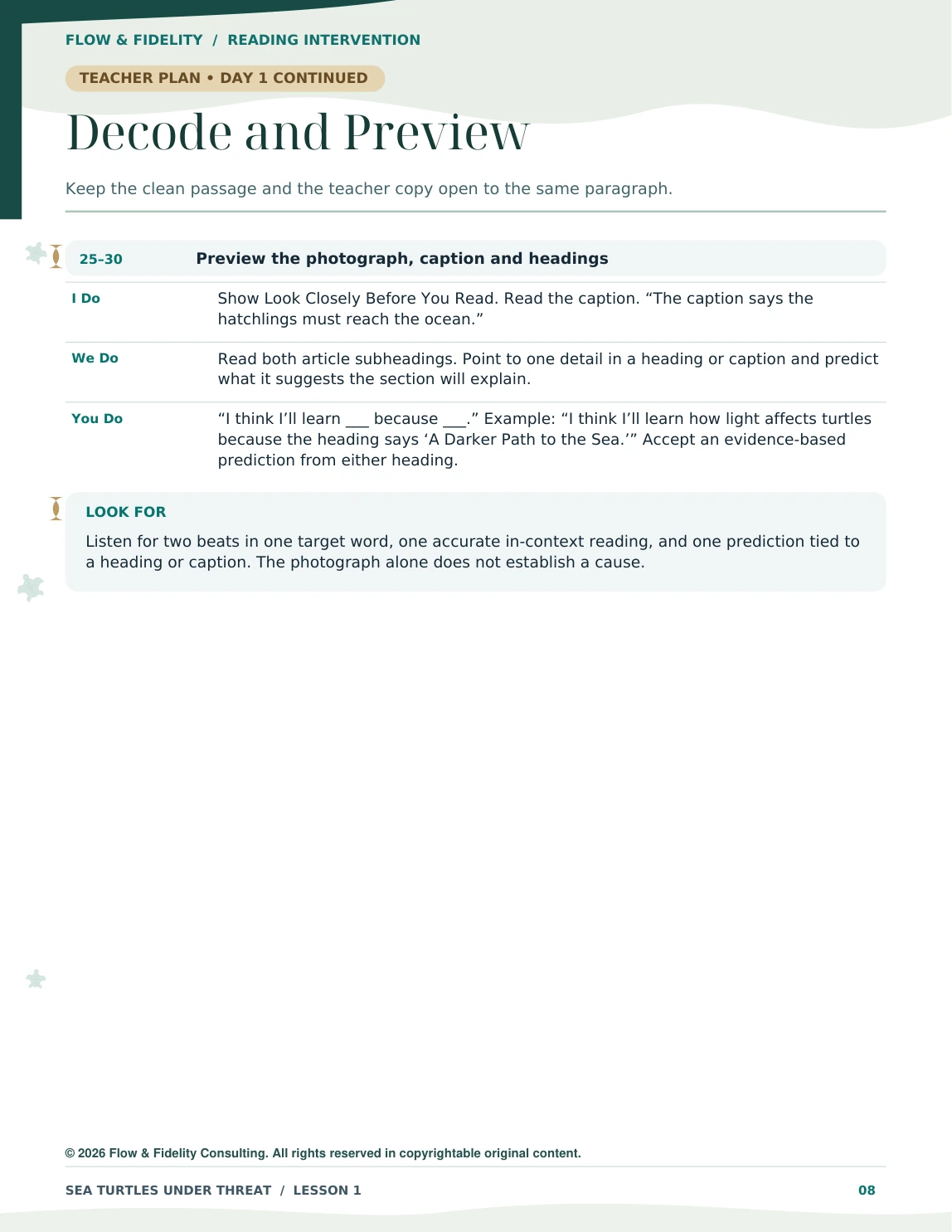
 25–30          Preview the photograph, caption and headings

I Do               Show Look Closely Before You Read. Read the caption. “The caption says the
                   hatchlings must reach the ocean.”

We Do              Read both article subheadings. Point to one detail in a heading or caption and predict
                   what it suggests the section will explain.

You Do             “I think I’ll learn ___ because ___.” Example: “I think I’ll learn how light affects turtles
                   because the heading says ‘A Darker Path to the Sea.’” Accept an evidence-based
                   prediction from either heading.


  LOOK FOR

  Listen for two beats in one target word, one accurate in-context reading, and one prediction tied to
  a heading or caption. The photograph alone does not establish a cause.


SEA TURTLES UNDER THREAT / LESSON 1                                                                          08

© 2026 Flow & Fidelity Consulting. All rights reserved in copyrightable original content.
Day 1 passage word cards · Page 17
Read selectable page text
FLOW & FIDELITY / READING INTERVENTION

 TEACHER MATERIALS • DAY 1


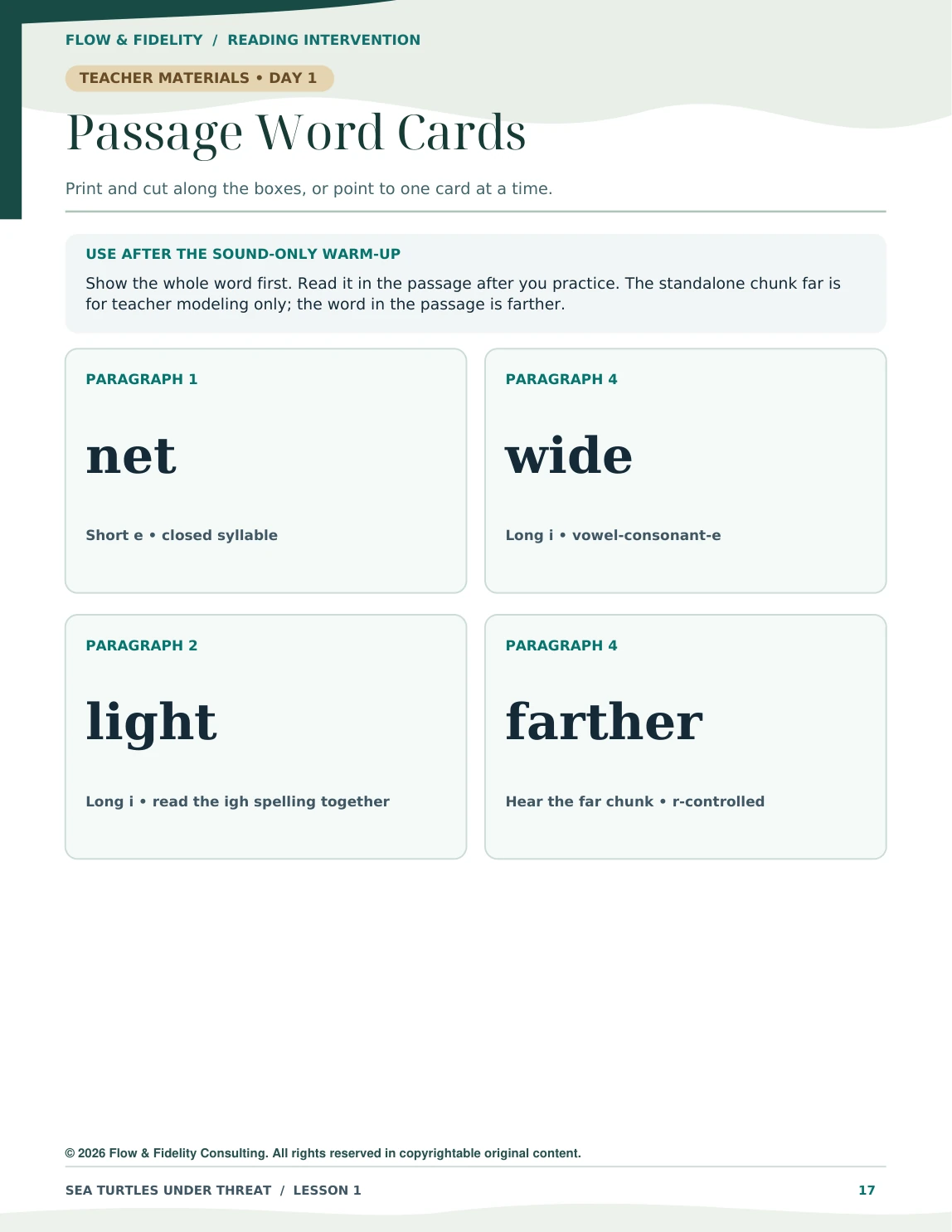
Passage Word Cards
Print and cut along the boxes, or point to one card at a time.


  USE AFTER THE SOUND-ONLY WARM-UP

  Show the whole word first. Read it in the passage after you practice. The standalone chunk far is
  for teacher modeling only; the word in the passage is farther.


  PARAGRAPH 1                                          PARAGRAPH 4


  net                                                  wide
  Short e • closed syllable                            Long i • vowel-consonant-e


  PARAGRAPH 2                                          PARAGRAPH 4


  light                                                farther
  Long i • read the igh spelling together              Hear the far chunk • r-controlled


SEA TURTLES UNDER THREAT / LESSON 1                                                                   17

© 2026 Flow & Fidelity Consulting. All rights reserved in copyrightable original content.
Day 2 · TuesdayReread With Purpose30 minutes · Vocabulary, fluency, cause and effect, written evidence.
Shared materials: Student passage · Teacher annotated passage
Teacher plan · Page 9
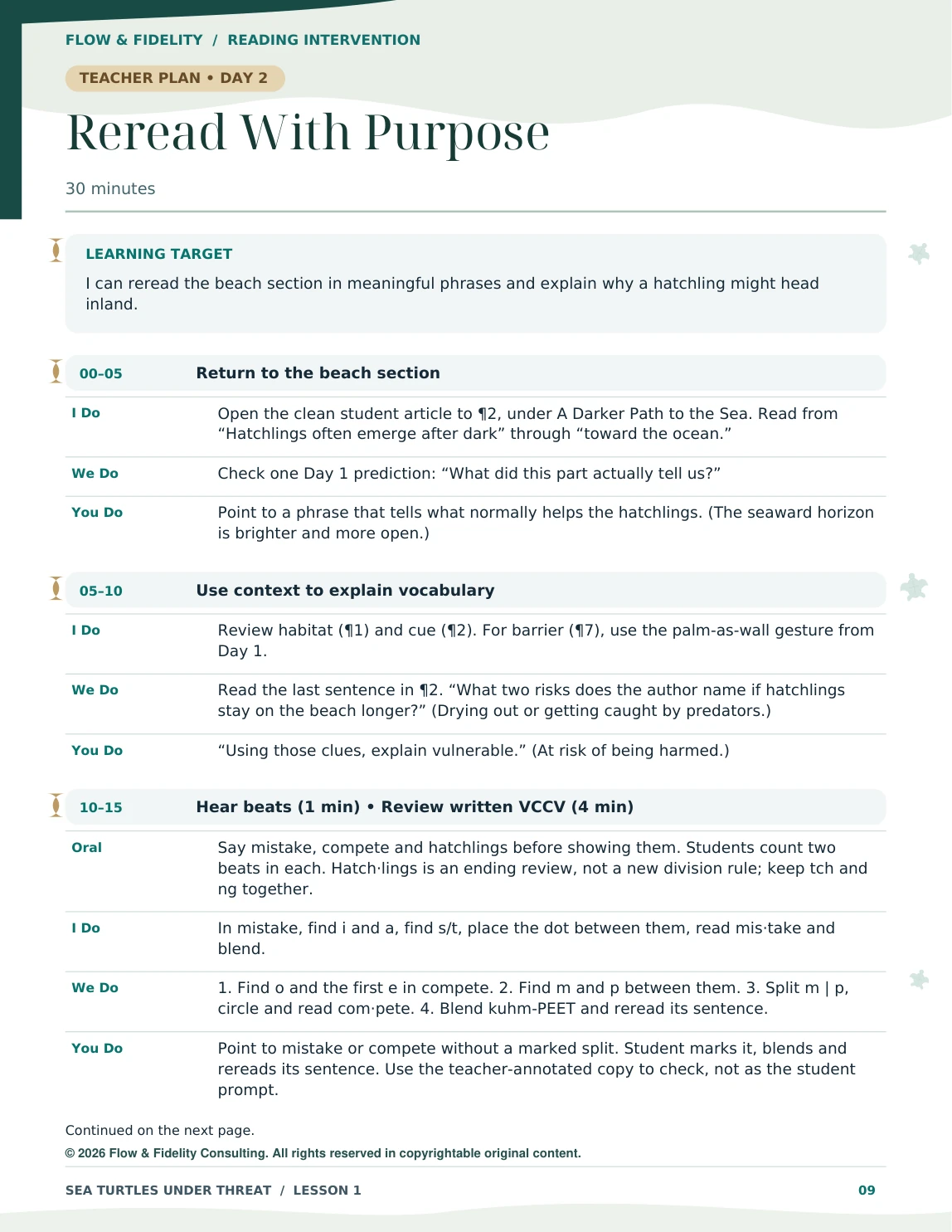
Read selectable page text
FLOW & FIDELITY / READING INTERVENTION

 TEACHER PLAN • DAY 2


Reread With Purpose
30 minutes


  LEARNING TARGET

  I can reread the beach section in meaningful phrases and explain why a hatchling might head
  inland.


 00–05            Return to the beach section

I Do                 Open the clean student article to ¶2, under A Darker Path to the Sea. Read from
                     “Hatchlings often emerge after dark” through “toward the ocean.”

We Do                Check one Day 1 prediction: “What did this part actually tell us?”

You Do               Point to a phrase that tells what normally helps the hatchlings. (The seaward horizon
                     is brighter and more open.)


 05–10            Use context to explain vocabulary

I Do                 Review habitat (¶1) and cue (¶2). For barrier (¶7), use the palm-as-wall gesture from
                     Day 1.

We Do                Read the last sentence in ¶2. “What two risks does the author name if hatchlings
                     stay on the beach longer?” (Drying out or getting caught by predators.)

You Do               “Using those clues, explain vulnerable.” (At risk of being harmed.)


 10–15            Hear beats (1 min) • Review written VCCV (4 min)

Oral                 Say mistake, compete and hatchlings before showing them. Students count two
                     beats in each. Hatch·lings is an ending review, not a new division rule; keep tch and
                     ng together.

I Do                 In mistake, find i and a, find s/t, place the dot between them, read mis·take and
                     blend.

We Do                1. Find o and the first e in compete. 2. Find m and p between them. 3. Split m | p,
                     circle and read com·pete. 4. Blend kuhm-PEET and reread its sentence.

You Do               Point to mistake or compete without a marked split. Student marks it, blends and
                     rereads its sentence. Use the teacher-annotated copy to check, not as the student
                     prompt.

Continued on the next page.


SEA TURTLES UNDER THREAT / LESSON 1                                                                        09

© 2026 Flow & Fidelity Consulting. All rights reserved in copyrightable original content.
Teacher plan continued · Page 10
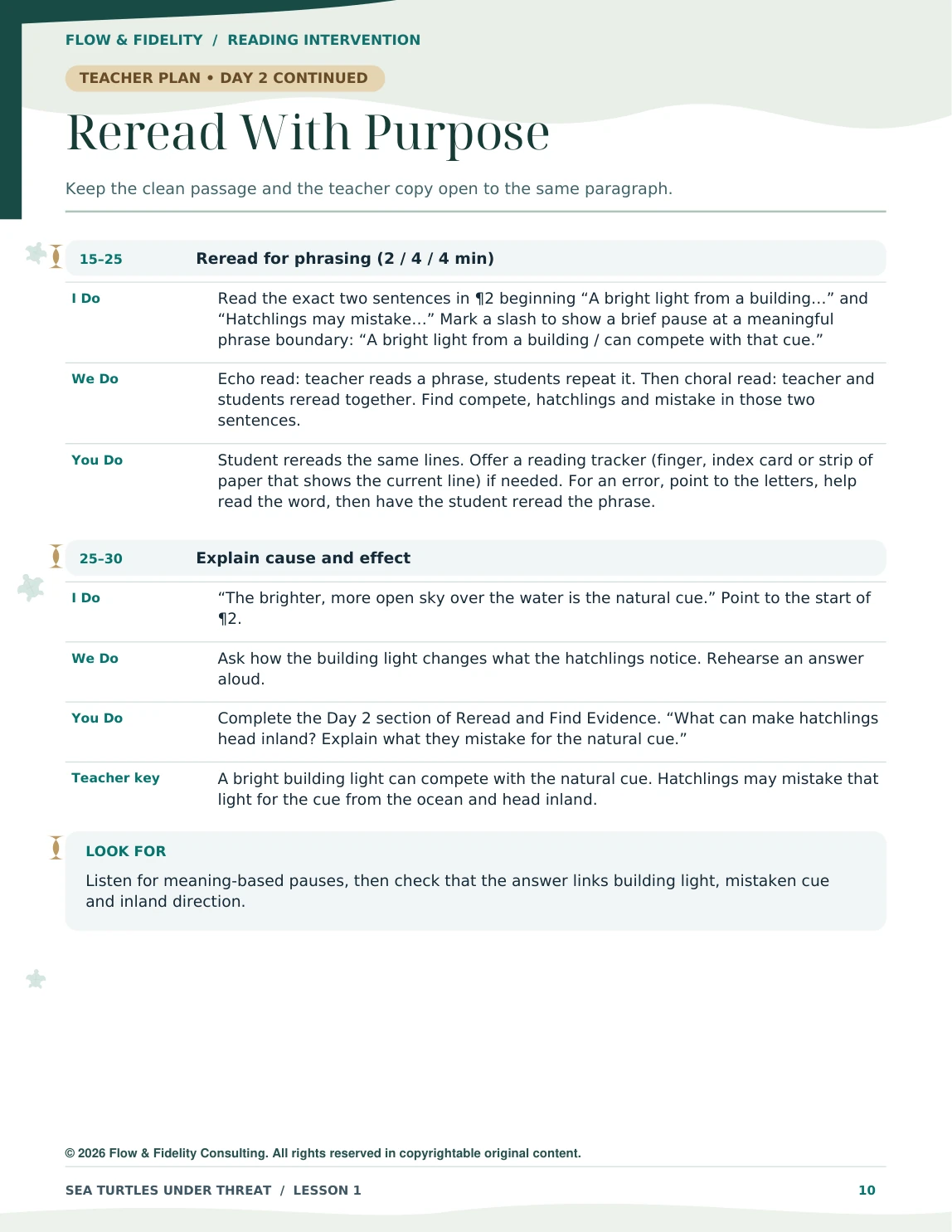
Read selectable page text
FLOW & FIDELITY / READING INTERVENTION

 TEACHER PLAN • DAY 2 CONTINUED


Reread With Purpose
Keep the clean passage and the teacher copy open to the same paragraph.


 15–25         Reread for phrasing (2 / 4 / 4 min)

I Do              Read the exact two sentences in ¶2 beginning “A bright light from a building…” and
                  “Hatchlings may mistake…” Mark a slash to show a brief pause at a meaningful
                  phrase boundary: “A bright light from a building / can compete with that cue.”

We Do             Echo read: teacher reads a phrase, students repeat it. Then choral read: teacher and
                  students reread together. Find compete, hatchlings and mistake in those two
                  sentences.

You Do            Student rereads the same lines. Offer a reading tracker (finger, index card or strip of
                  paper that shows the current line) if needed. For an error, point to the letters, help
                  read the word, then have the student reread the phrase.


 25–30         Explain cause and effect

I Do              “The brighter, more open sky over the water is the natural cue.” Point to the start of
                  ¶2.

We Do             Ask how the building light changes what the hatchlings notice. Rehearse an answer
                  aloud.

You Do            Complete the Day 2 section of Reread and Find Evidence. “What can make hatchlings
                  head inland? Explain what they mistake for the natural cue.”

Teacher key       A bright building light can compete with the natural cue. Hatchlings may mistake that
                  light for the cue from the ocean and head inland.


  LOOK FOR

  Listen for meaning-based pauses, then check that the answer links building light, mistaken cue
  and inland direction.


SEA TURTLES UNDER THREAT / LESSON 1                                                                    10

© 2026 Flow & Fidelity Consulting. All rights reserved in copyrightable original content.
Days 2 and 3 student response · Page 19
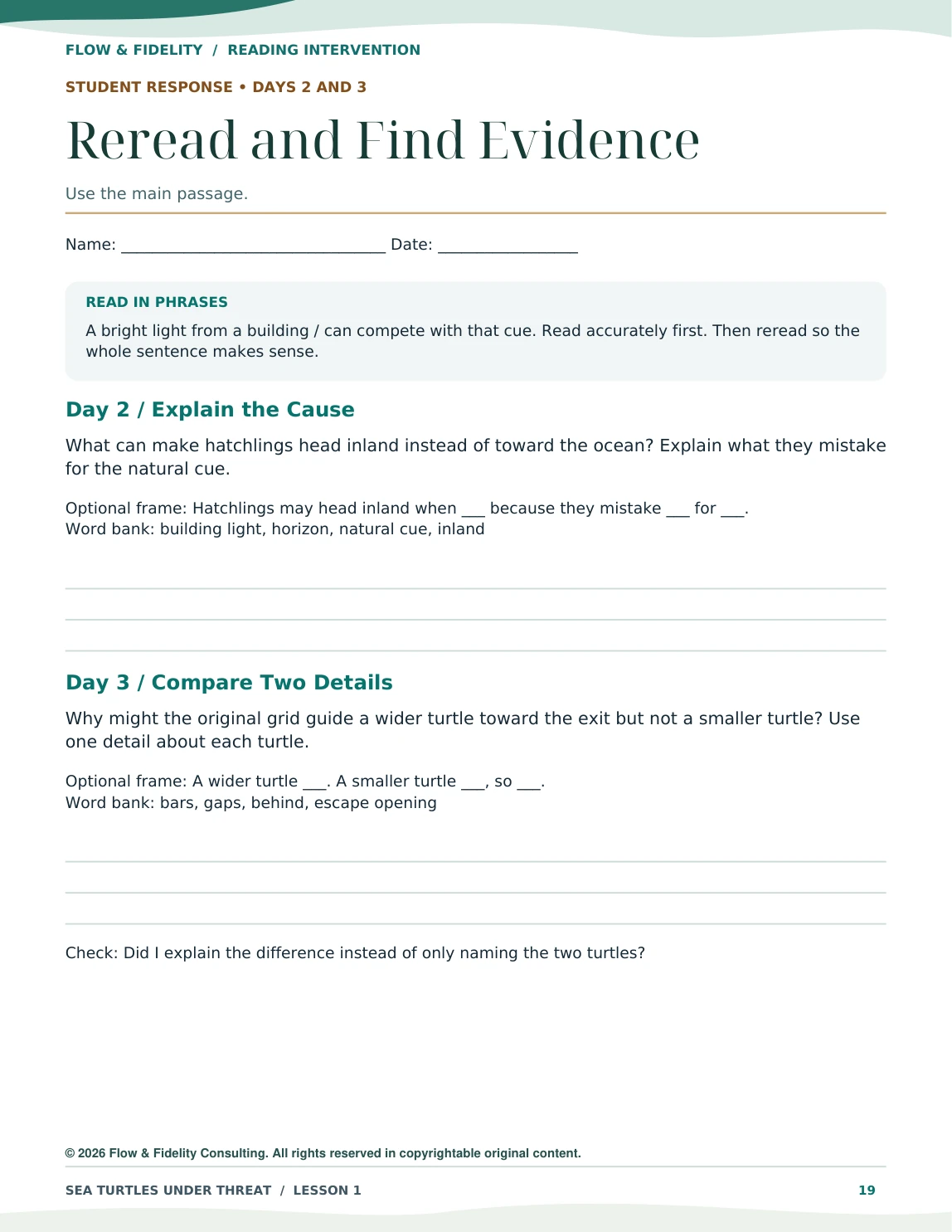
Read selectable page text
FLOW & FIDELITY / READING INTERVENTION

STUDENT RESPONSE • DAYS 2 AND 3


Reread and Find Evidence
Use the main passage.


Name: __________________________________ Date: __________________


  READ IN PHRASES

  A bright light from a building / can compete with that cue. Read accurately first. Then reread so the
  whole sentence makes sense.


Day 2 / Explain the Cause
What can make hatchlings head inland instead of toward the ocean? Explain what they mistake
for the natural cue.

Optional frame: Hatchlings may head inland when ___ because they mistake ___ for ___.
Word bank: building light, horizon, natural cue, inland


Day 3 / Compare Two Details
Why might the original grid guide a wider turtle toward the exit but not a smaller turtle? Use
one detail about each turtle.

Optional frame: A wider turtle ___. A smaller turtle ___, so ___.
Word bank: bars, gaps, behind, escape opening


Check: Did I explain the difference instead of only naming the two turtles?


SEA TURTLES UNDER THREAT / LESSON 1                                                                   19

© 2026 Flow & Fidelity Consulting. All rights reserved in copyrightable original content.
Day 3 · WednesdayCompare and Write With Evidence30 minutes · Use the labeled fishing-net diagram, compare routes and write with evidence.
Shared materials: Student passage · Teacher annotated passage · Days 2 and 3 student response
Teacher plan · Page 11
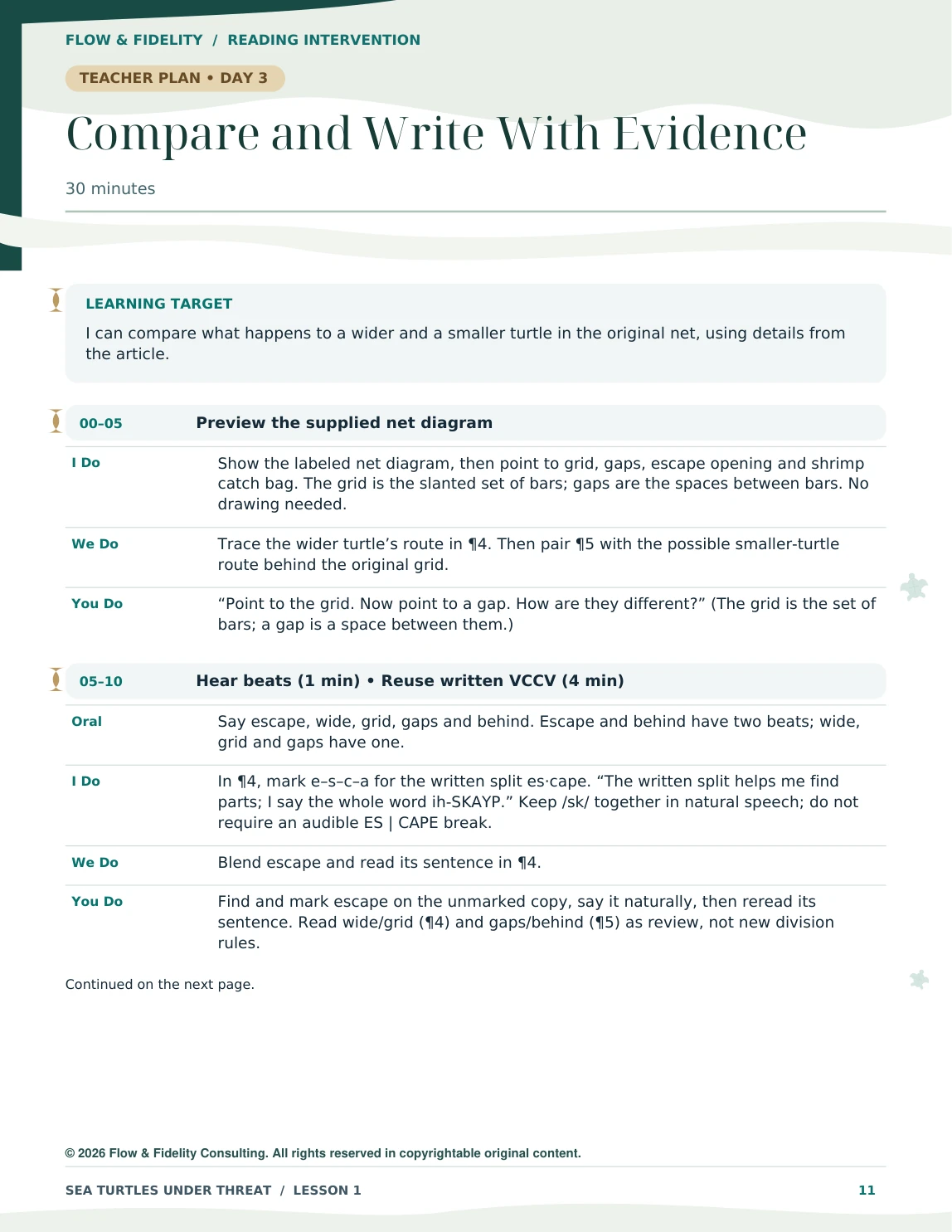
Read selectable page text
FLOW & FIDELITY / READING INTERVENTION

 TEACHER PLAN • DAY 3


Compare and Write With Evidence
30 minutes


  LEARNING TARGET

  I can compare what happens to a wider and a smaller turtle in the original net, using details from
  the article.


 00–05            Preview the supplied net diagram

I Do                 Show the labeled net diagram, then point to grid, gaps, escape opening and shrimp
                     catch bag. The grid is the slanted set of bars; gaps are the spaces between bars. No
                     drawing needed.

We Do                Trace the wider turtle’s route in ¶4. Then pair ¶5 with the possible smaller-turtle
                     route behind the original grid.

You Do               “Point to the grid. Now point to a gap. How are they different?” (The grid is the set of
                     bars; a gap is a space between them.)


 05–10            Hear beats (1 min) • Reuse written VCCV (4 min)

Oral                 Say escape, wide, grid, gaps and behind. Escape and behind have two beats; wide,
                     grid and gaps have one.

I Do                 In ¶4, mark e–s–c–a for the written split es·cape. “The written split helps me find
                     parts; I say the whole word ih-SKAYP.” Keep /sk/ together in natural speech; do not
                     require an audible ES | CAPE break.

We Do                Blend escape and read its sentence in ¶4.

You Do               Find and mark escape on the unmarked copy, say it naturally, then reread its
                     sentence. Read wide/grid (¶4) and gaps/behind (¶5) as review, not new division
                     rules.

Continued on the next page.


SEA TURTLES UNDER THREAT / LESSON 1                                                                        11

© 2026 Flow & Fidelity Consulting. All rights reserved in copyrightable original content.
Teacher plan continued · Page 12
Read selectable page text
FLOW & FIDELITY / READING INTERVENTION

 TEACHER PLAN • DAY 3 CONTINUED


Compare and Write With Evidence
Keep the clean passage and the teacher copy open to the same paragraph.


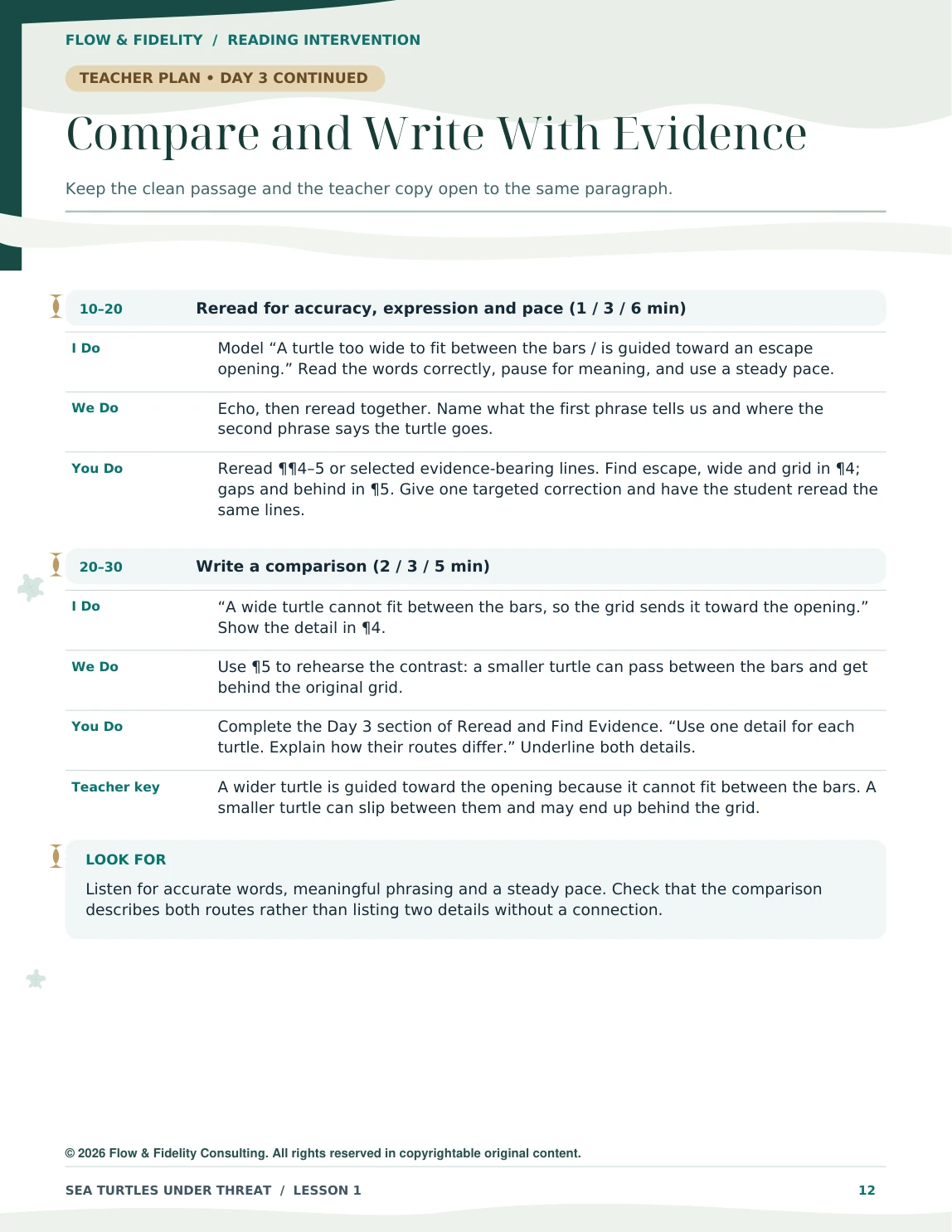
 10–20         Reread for accuracy, expression and pace (1 / 3 / 6 min)

I Do              Model “A turtle too wide to fit between the bars / is guided toward an escape
                  opening.” Read the words correctly, pause for meaning, and use a steady pace.

We Do             Echo, then reread together. Name what the first phrase tells us and where the
                  second phrase says the turtle goes.

You Do            Reread ¶¶4–5 or selected evidence-bearing lines. Find escape, wide and grid in ¶4;
                  gaps and behind in ¶5. Give one targeted correction and have the student reread the
                  same lines.


 20–30         Write a comparison (2 / 3 / 5 min)

I Do              “A wide turtle cannot fit between the bars, so the grid sends it toward the opening.”
                  Show the detail in ¶4.

We Do             Use ¶5 to rehearse the contrast: a smaller turtle can pass between the bars and get
                  behind the original grid.

You Do            Complete the Day 3 section of Reread and Find Evidence. “Use one detail for each
                  turtle. Explain how their routes differ.” Underline both details.

Teacher key       A wider turtle is guided toward the opening because it cannot fit between the bars. A
                  smaller turtle can slip between them and may end up behind the grid.


  LOOK FOR

  Listen for accurate words, meaningful phrasing and a steady pace. Check that the comparison
  describes both routes rather than listing two details without a connection.


SEA TURTLES UNDER THREAT / LESSON 1                                                                  12

© 2026 Flow & Fidelity Consulting. All rights reserved in copyrightable original content.
Ready-to-use net diagram · Page 15
Read selectable page text
FLOW & FIDELITY / READING INTERVENTION

  DAY 3 • READY-TO-USE VISUAL


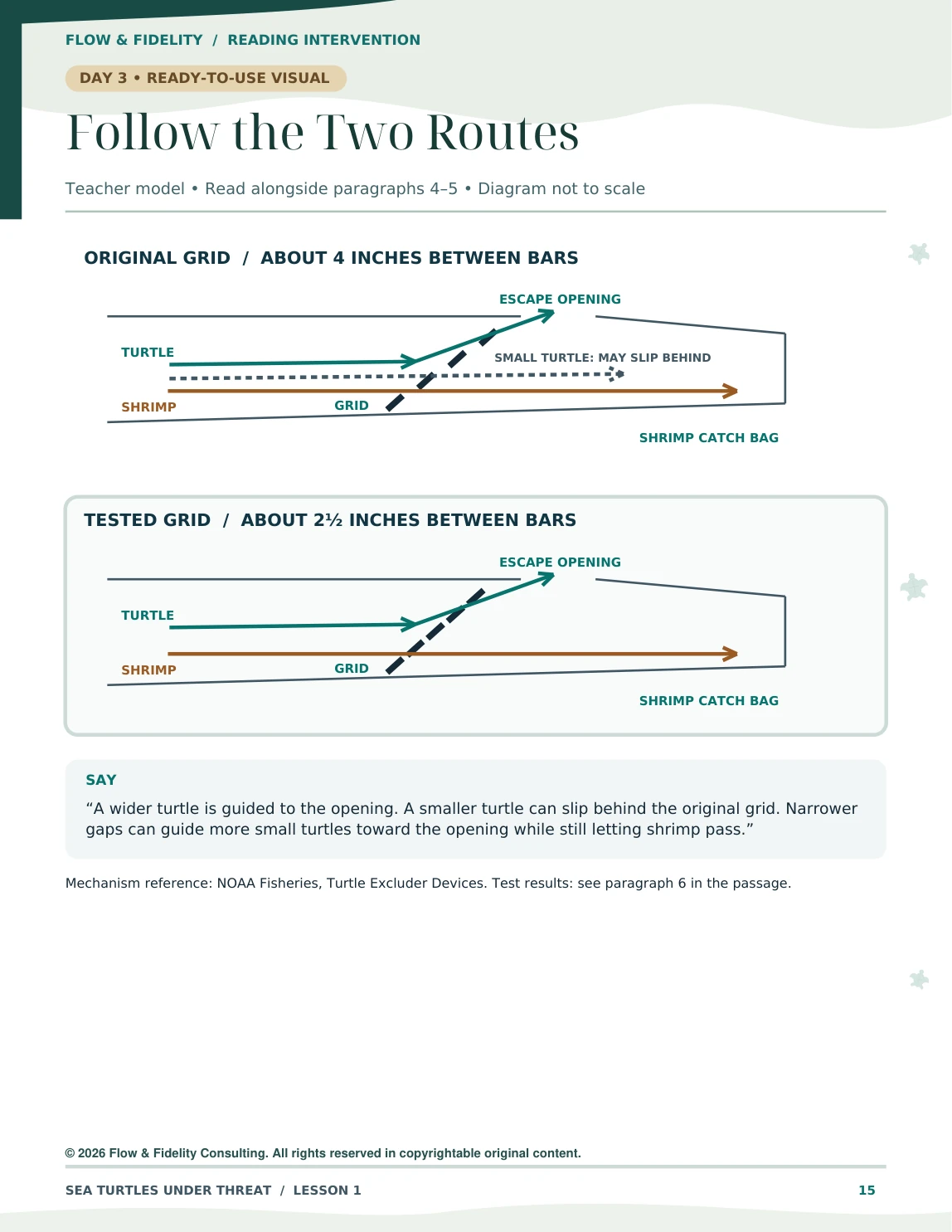
Follow the Two Routes
Teacher model • Read alongside paragraphs 4–5 • Diagram not to scale


  ORIGINAL GRID / ABOUT 4 INCHES BETWEEN BARS

                                                               ESCAPE OPENING


        TURTLE                                                 SMALL TURTLE: MAY SLIP BEHIND


        SHRIMP                         GRID

                                                                                    SHRIMP CATCH BAG


  TESTED GRID / ABOUT 2½ INCHES BETWEEN BARS

                                                               ESCAPE OPENING


        TURTLE


        SHRIMP                         GRID

                                                                                    SHRIMP CATCH BAG


  SAY

  “A wider turtle is guided to the opening. A smaller turtle can slip behind the original grid. Narrower
  gaps can guide more small turtles toward the opening while still letting shrimp pass.”


Mechanism reference: NOAA Fisheries, Turtle Excluder Devices. Test results: see paragraph 6 in the passage.


SEA TURTLES UNDER THREAT / LESSON 1                                                                           15

© 2026 Flow & Fidelity Consulting. All rights reserved in copyrightable original content.
Day 4 · ThursdayApply and Explain30 minutes · Explain both solutions using details from each section; optional choice menu.
Shared materials: Student passage · Teacher annotated passage
Teacher plan · Page 13
Read selectable page text
FLOW & FIDELITY / READING INTERVENTION

 TEACHER PLAN • DAY 4


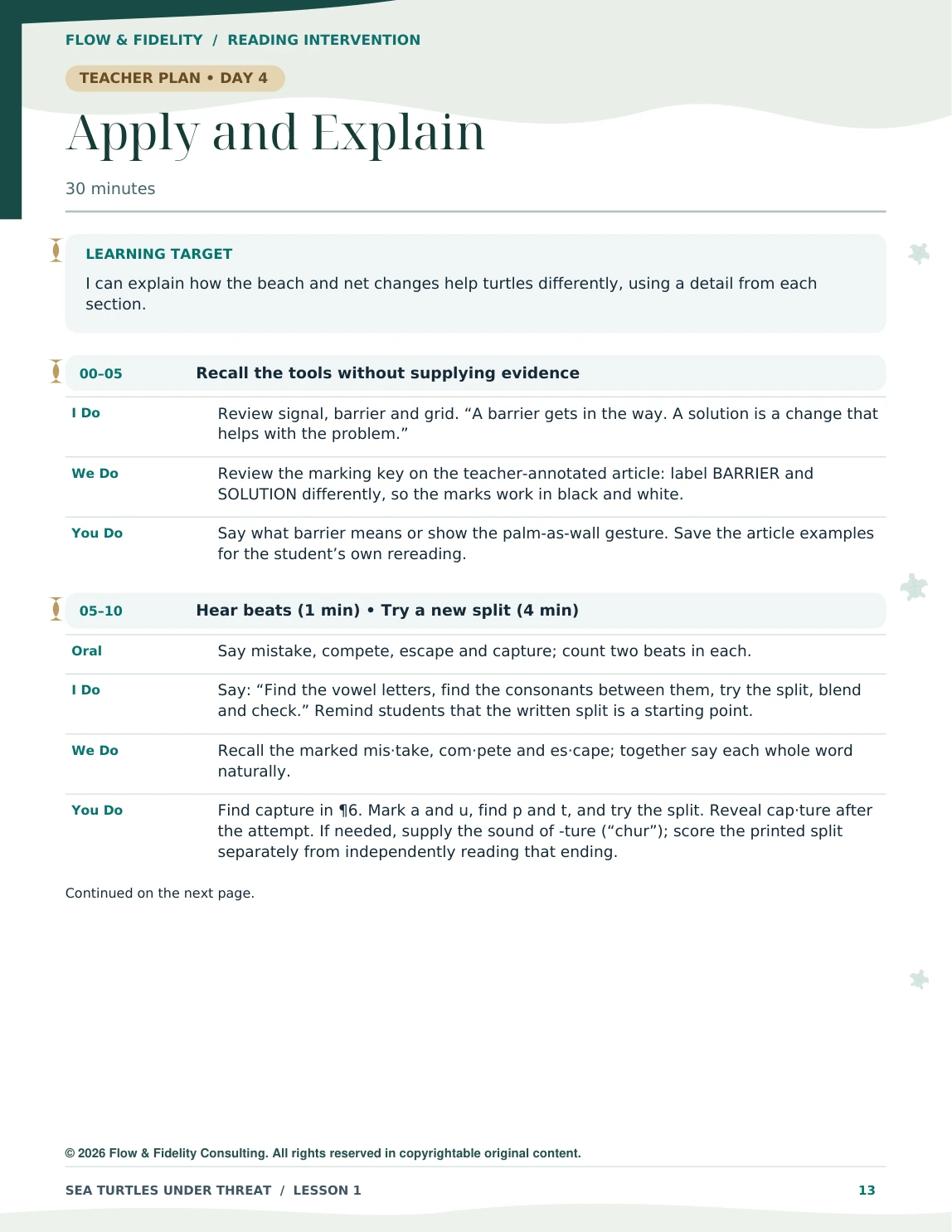
Apply and Explain
30 minutes


  LEARNING TARGET

  I can explain how the beach and net changes help turtles differently, using a detail from each
  section.


 00–05            Recall the tools without supplying evidence

I Do                 Review signal, barrier and grid. “A barrier gets in the way. A solution is a change that
                     helps with the problem.”

We Do                Review the marking key on the teacher-annotated article: label BARRIER and
                     SOLUTION differently, so the marks work in black and white.

You Do               Say what barrier means or show the palm-as-wall gesture. Save the article examples
                     for the student’s own rereading.


 05–10            Hear beats (1 min) • Try a new split (4 min)

Oral                 Say mistake, compete, escape and capture; count two beats in each.

I Do                 Say: “Find the vowel letters, find the consonants between them, try the split, blend
                     and check.” Remind students that the written split is a starting point.

We Do                Recall the marked mis·take, com·pete and es·cape; together say each whole word
                     naturally.

You Do               Find capture in ¶6. Mark a and u, find p and t, and try the split. Reveal cap·ture after
                     the attempt. If needed, supply the sound of -ture (“chur”); score the printed split
                     separately from independently reading that ending.

Continued on the next page.


SEA TURTLES UNDER THREAT / LESSON 1                                                                        13

© 2026 Flow & Fidelity Consulting. All rights reserved in copyrightable original content.
Teacher plan continued · Page 14
Read selectable page text
FLOW & FIDELITY / READING INTERVENTION

 TEACHER PLAN • DAY 4 CONTINUED


Apply and Explain
Keep the clean passage and the teacher copy open to the same paragraph.


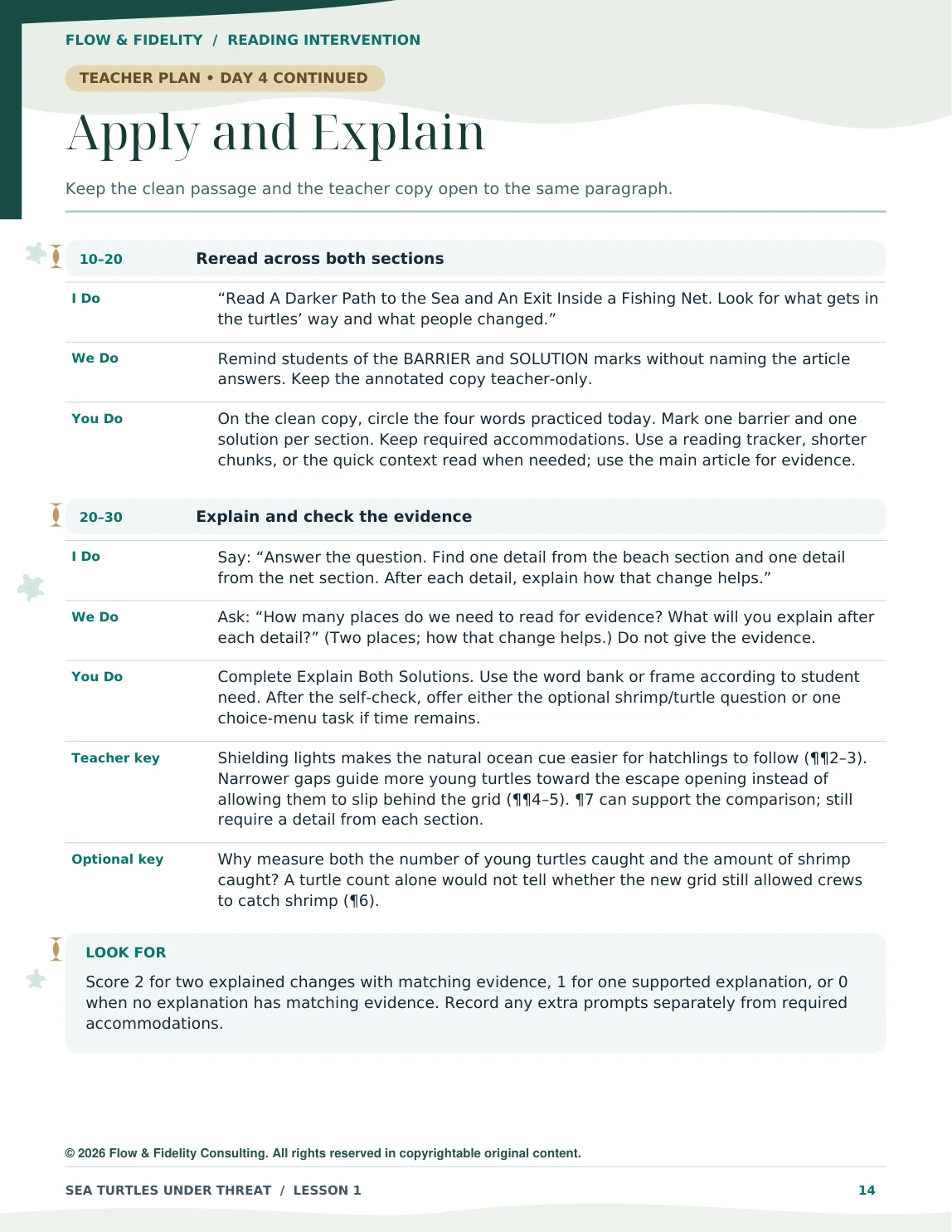
 10–20         Reread across both sections

I Do              “Read A Darker Path to the Sea and An Exit Inside a Fishing Net. Look for what gets in
                  the turtles’ way and what people changed.”

We Do             Remind students of the BARRIER and SOLUTION marks without naming the article
                  answers. Keep the annotated copy teacher-only.

You Do            On the clean copy, circle the four words practiced today. Mark one barrier and one
                  solution per section. Keep required accommodations. Use a reading tracker, shorter
                  chunks, or the quick context read when needed; use the main article for evidence.


 20–30         Explain and check the evidence

I Do              Say: “Answer the question. Find one detail from the beach section and one detail
                  from the net section. After each detail, explain how that change helps.”

We Do             Ask: “How many places do we need to read for evidence? What will you explain after
                  each detail?” (Two places; how that change helps.) Do not give the evidence.

You Do            Complete Explain Both Solutions. Use the word bank or frame according to student
                  need. After the self-check, offer either the optional shrimp/turtle question or one
                  choice-menu task if time remains.

Teacher key       Shielding lights makes the natural ocean cue easier for hatchlings to follow (¶¶2–3).
                  Narrower gaps guide more young turtles toward the escape opening instead of
                  allowing them to slip behind the grid (¶¶4–5). ¶7 can support the comparison; still
                  require a detail from each section.

Optional key      Why measure both the number of young turtles caught and the amount of shrimp
                  caught? A turtle count alone would not tell whether the new grid still allowed crews
                  to catch shrimp (¶6).


  LOOK FOR

  Score 2 for two explained changes with matching evidence, 1 for one supported explanation, or 0
  when no explanation has matching evidence. Record any extra prompts separately from required
  accommodations.


SEA TURTLES UNDER THREAT / LESSON 1                                                                  14

© 2026 Flow & Fidelity Consulting. All rights reserved in copyrightable original content.
Day 4 student response · Page 20
Read selectable page text
FLOW & FIDELITY / READING INTERVENTION

STUDENT RESPONSE • DAY 4


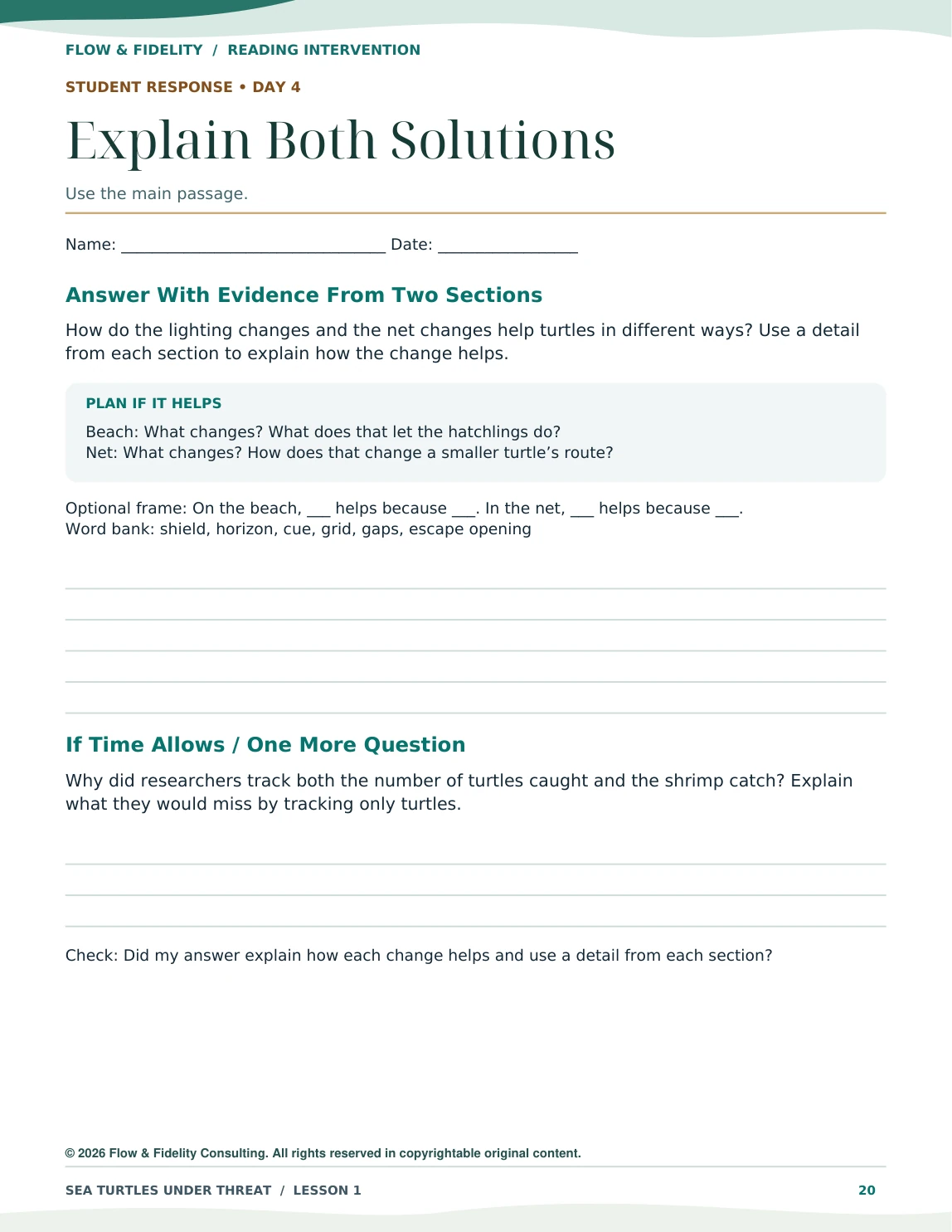
Explain Both Solutions
Use the main passage.


Name: __________________________________ Date: __________________


Answer With Evidence From Two Sections
How do the lighting changes and the net changes help turtles in different ways? Use a detail
from each section to explain how the change helps.

  PLAN IF IT HELPS

  Beach: What changes? What does that let the hatchlings do?
  Net: What changes? How does that change a smaller turtle’s route?


Optional frame: On the beach, ___ helps because ___. In the net, ___ helps because ___.
Word bank: shield, horizon, cue, grid, gaps, escape opening


If Time Allows / One More Question
Why did researchers track both the number of turtles caught and the shrimp catch? Explain
what they would miss by tracking only turtles.


Check: Did my answer explain how each change helps and use a detail from each section?


SEA TURTLES UNDER THREAT / LESSON 1                                                         20

© 2026 Flow & Fidelity Consulting. All rights reserved in copyrightable original content.
Student choice menu · Page 21
Read selectable page text
FLOW & FIDELITY / READING INTERVENTION

STUDENT CHOICE MENU


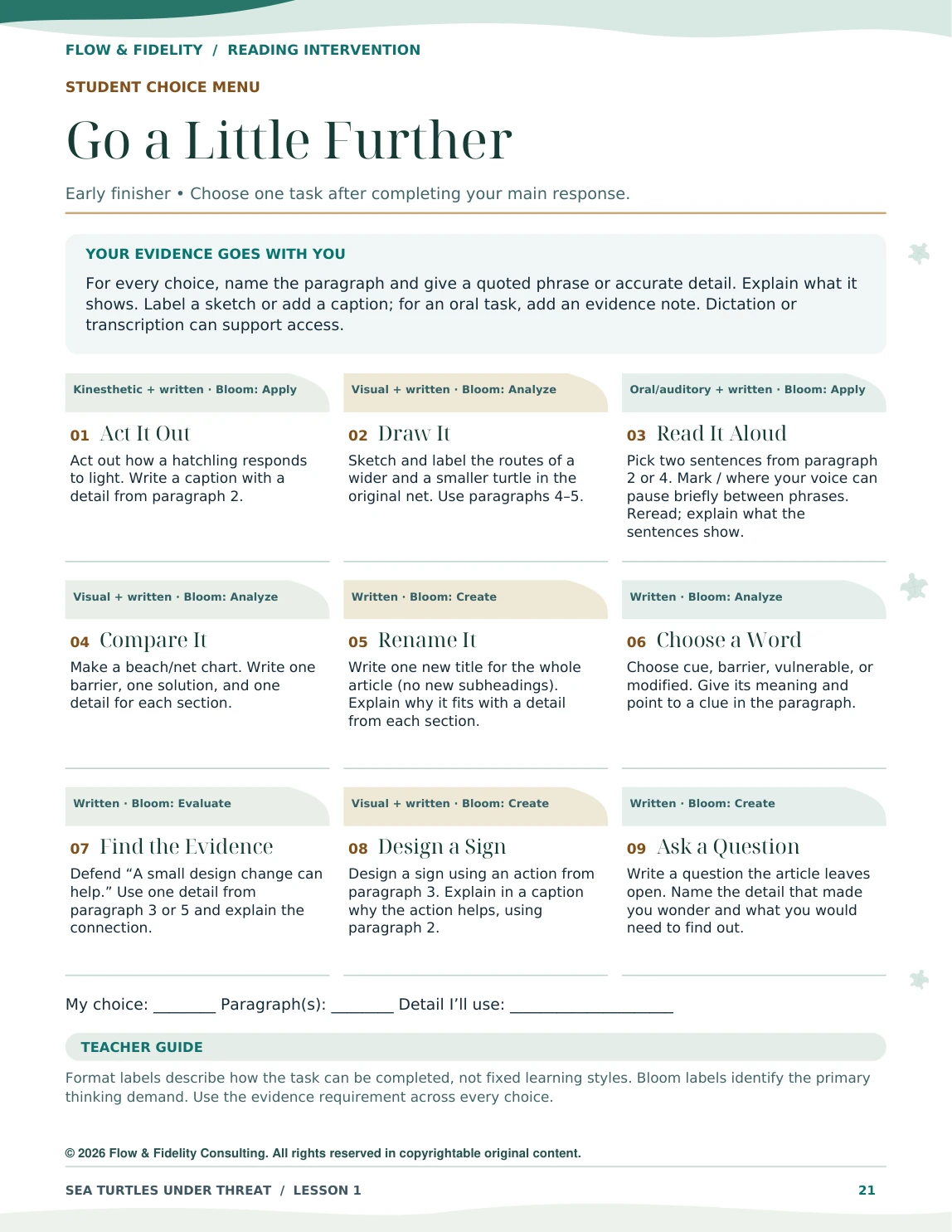
Go a Little Further
Early finisher • Choose one task after completing your main response.


   YOUR EVIDENCE GOES WITH YOU

   For every choice, name the paragraph and give a quoted phrase or accurate detail. Explain what it
   shows. Label a sketch or add a caption; for an oral task, add an evidence note. Dictation or
   transcription can support access.


 Kinesthetic + written · Bloom: Apply   Visual + written · Bloom: Analyze      Oral/auditory + written · Bloom: Apply


01 Act It Out                           02 Draw It                             03 Read It Aloud
Act out how a hatchling responds        Sketch and label the routes of a       Pick two sentences from paragraph
to light. Write a caption with a        wider and a smaller turtle in the      2 or 4. Mark / where your voice can
detail from paragraph 2.                original net. Use paragraphs 4–5.      pause briefly between phrases.
                                                                               Reread; explain what the
                                                                               sentences show.


 Visual + written · Bloom: Analyze      Written · Bloom: Create                Written · Bloom: Analyze


04 Compare It                           05 Rename It                           06 Choose a Word
Make a beach/net chart. Write one       Write one new title for the whole      Choose cue, barrier, vulnerable, or
barrier, one solution, and one          article (no new subheadings).          modified. Give its meaning and
detail for each section.                Explain why it fits with a detail      point to a clue in the paragraph.
                                        from each section.


 Written · Bloom: Evaluate              Visual + written · Bloom: Create       Written · Bloom: Create


07 Find the Evidence                    08 Design a Sign                       09 Ask a Question
Defend “A small design change can       Design a sign using an action from     Write a question the article leaves
help.” Use one detail from              paragraph 3. Explain in a caption      open. Name the detail that made
paragraph 3 or 5 and explain the        why the action helps, using            you wonder and what you would
connection.                             paragraph 2.                           need to find out.


My choice: ________ Paragraph(s): ________ Detail I’ll use: _____________________

  TEACHER GUIDE

Format labels describe how the task can be completed, not fixed learning styles. Bloom labels identify the primary
thinking demand. Use the evidence requirement across every choice.


SEA TURTLES UNDER THREAT / LESSON 1                                                                                21

© 2026 Flow & Fidelity Consulting. All rights reserved in copyrightable original content.
Day 5 · Friday (optional)Reading Check30 minutes · Teacher directions, supported or independent written response, separate teacher scoring key.
Shared materials: Student passage · Teacher annotated passage
Friday teacher directions · Page 23
Read selectable page text
FLOW & FIDELITY / READING INTERVENTION

 TEACHER PLAN • OPTIONAL DAY 5


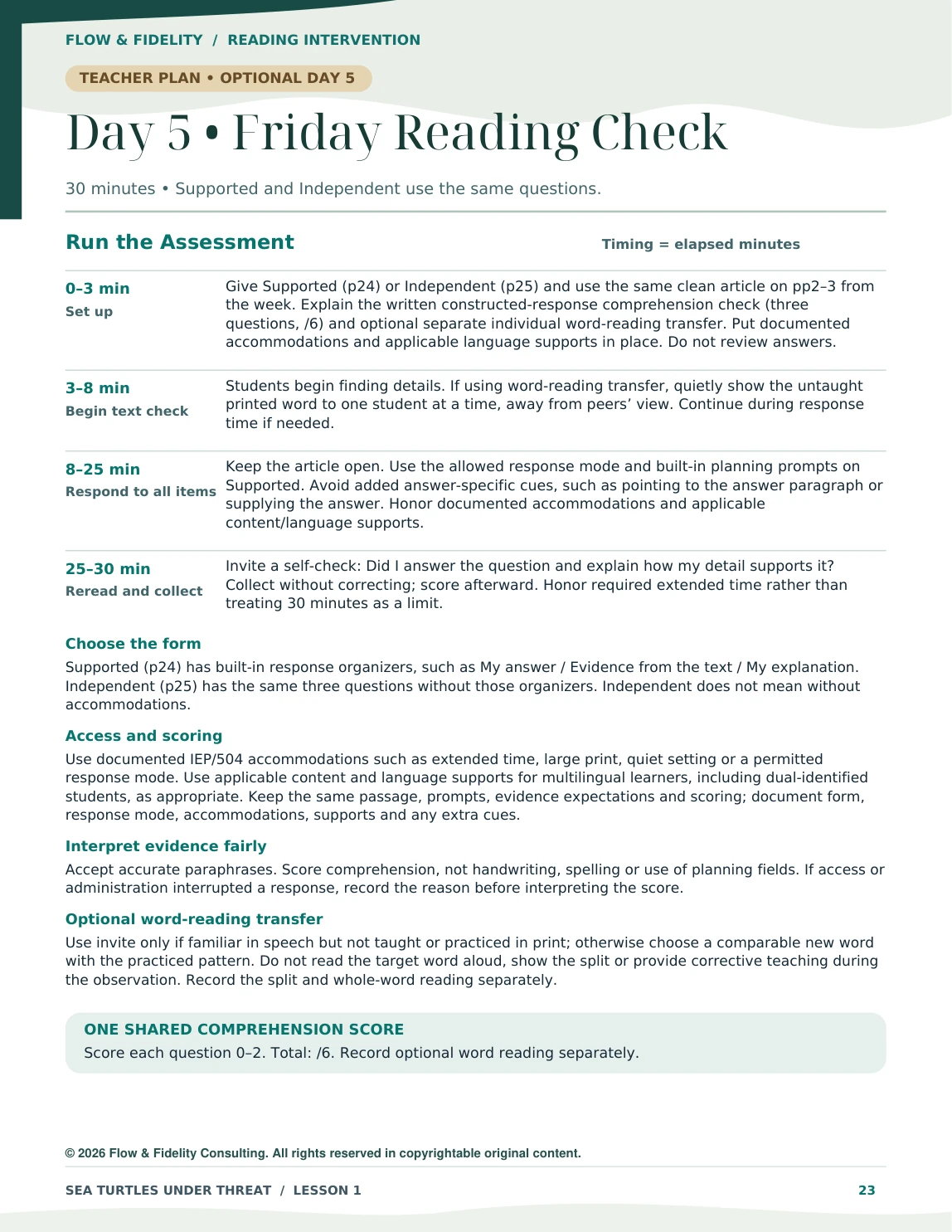
Day 5 • Friday Reading Check
30 minutes • Supported and Independent use the same questions.


Run the Assessment                                                         Timing = elapsed minutes


0–3 min               Give Supported (p24) or Independent (p25) and use the same clean article on pp2–3 from
Set up                the week. Explain the written constructed-response comprehension check (three
                      questions, /6) and optional separate individual word-reading transfer. Put documented
                      accommodations and applicable language supports in place. Do not review answers.


3–8 min               Students begin finding details. If using word-reading transfer, quietly show the untaught
Begin text check      printed word to one student at a time, away from peers’ view. Continue during response
                      time if needed.


8–25 min             Keep the article open. Use the allowed response mode and built-in planning prompts on
Respond to all items Supported. Avoid added answer-specific cues, such as pointing to the answer paragraph or
                     supplying the answer. Honor documented accommodations and applicable
                     content/language supports.


25–30 min             Invite a self-check: Did I answer the question and explain how my detail supports it?
Reread and collect    Collect without correcting; score afterward. Honor required extended time rather than
                      treating 30 minutes as a limit.

Choose the form
Supported (p24) has built-in response organizers, such as My answer / Evidence from the text / My explanation.
Independent (p25) has the same three questions without those organizers. Independent does not mean without
accommodations.

Access and scoring
Use documented IEP/504 accommodations such as extended time, large print, quiet setting or a permitted
response mode. Use applicable content and language supports for multilingual learners, including dual-identified
students, as appropriate. Keep the same passage, prompts, evidence expectations and scoring; document form,
response mode, accommodations, supports and any extra cues.

Interpret evidence fairly
Accept accurate paraphrases. Score comprehension, not handwriting, spelling or use of planning fields. If access or
administration interrupted a response, record the reason before interpreting the score.

Optional word-reading transfer
Use invite only if familiar in speech but not taught or practiced in print; otherwise choose a comparable new word
with the practiced pattern. Do not read the target word aloud, show the split or provide corrective teaching during
the observation. Record the split and whole-word reading separately.


  ONE SHARED COMPREHENSION SCORE
  Score each question 0–2. Total: /6. Record optional word reading separately.


SEA TURTLES UNDER THREAT / LESSON 1                                                                             23

© 2026 Flow & Fidelity Consulting. All rights reserved in copyrightable original content.
Supported student reading check · Page 24
Read selectable page text
FLOW & FIDELITY / READING INTERVENTION

STUDENT ASSESSMENT • SUPPORTED


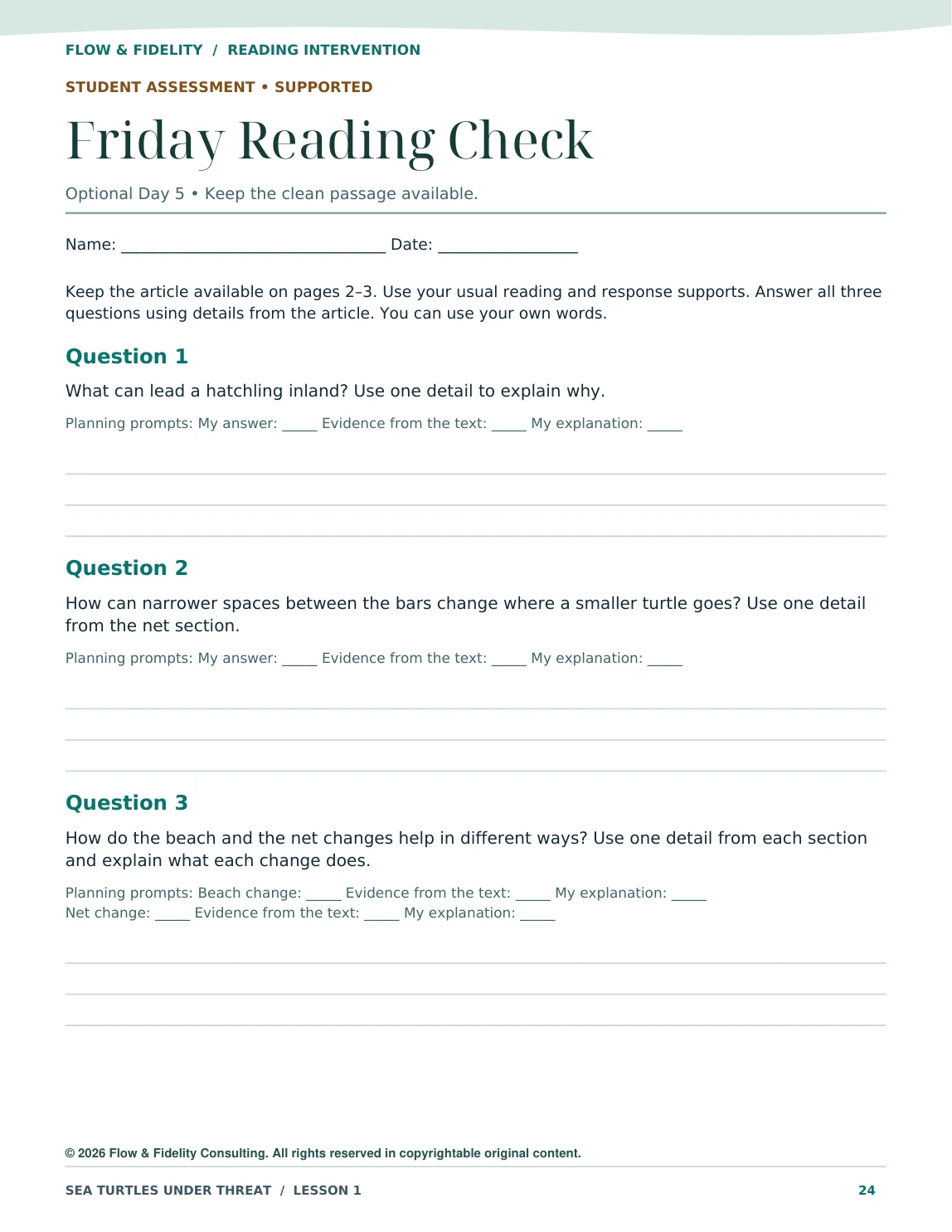
Friday Reading Check
Optional Day 5 • Keep the clean passage available.


Name: __________________________________ Date: __________________


Keep the article available on pages 2–3. Use your usual reading and response supports. Answer all three
questions using details from the article. You can use your own words.

Question 1
What can lead a hatchling inland? Use one detail to explain why.
Planning prompts: My answer: _____ Evidence from the text: _____ My explanation: _____


Question 2
How can narrower spaces between the bars change where a smaller turtle goes? Use one detail
from the net section.
Planning prompts: My answer: _____ Evidence from the text: _____ My explanation: _____


Question 3
How do the beach and the net changes help in different ways? Use one detail from each section
and explain what each change does.
Planning prompts: Beach change: _____ Evidence from the text: _____ My explanation: _____
Net change: _____ Evidence from the text: _____ My explanation: _____


SEA TURTLES UNDER THREAT / LESSON 1                                                                 24

© 2026 Flow & Fidelity Consulting. All rights reserved in copyrightable original content.
Independent student reading check · Page 25
Read selectable page text
FLOW & FIDELITY / READING INTERVENTION

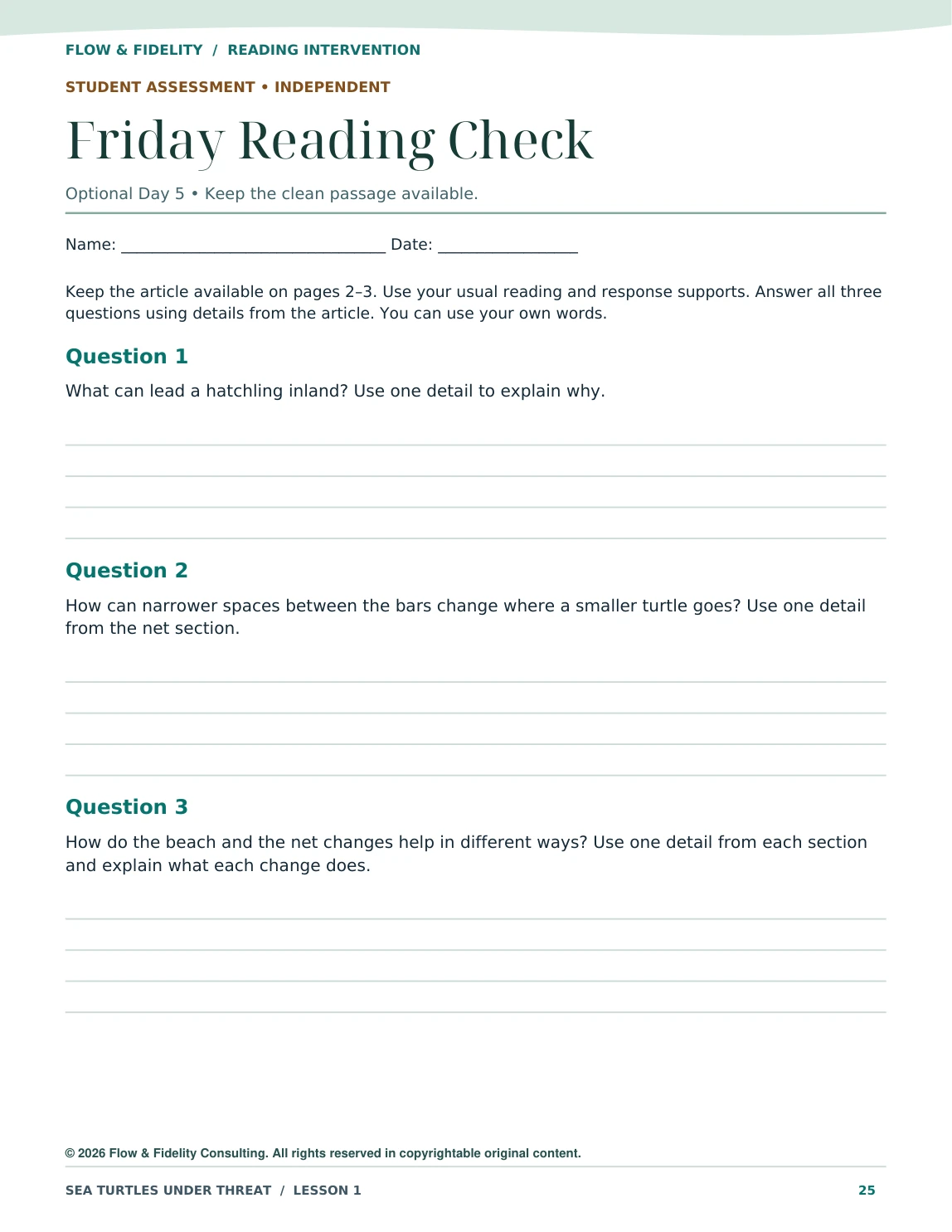
STUDENT ASSESSMENT • INDEPENDENT


Friday Reading Check
Optional Day 5 • Keep the clean passage available.


Name: __________________________________ Date: __________________


Keep the article available on pages 2–3. Use your usual reading and response supports. Answer all three
questions using details from the article. You can use your own words.

Question 1
What can lead a hatchling inland? Use one detail to explain why.


Question 2
How can narrower spaces between the bars change where a smaller turtle goes? Use one detail
from the net section.


Question 3
How do the beach and the net changes help in different ways? Use one detail from each section
and explain what each change does.


SEA TURTLES UNDER THREAT / LESSON 1                                                                 25

© 2026 Flow & Fidelity Consulting. All rights reserved in copyrightable original content.
Teacher scoring key · Page 26
Read selectable page text
FLOW & FIDELITY / READING INTERVENTION

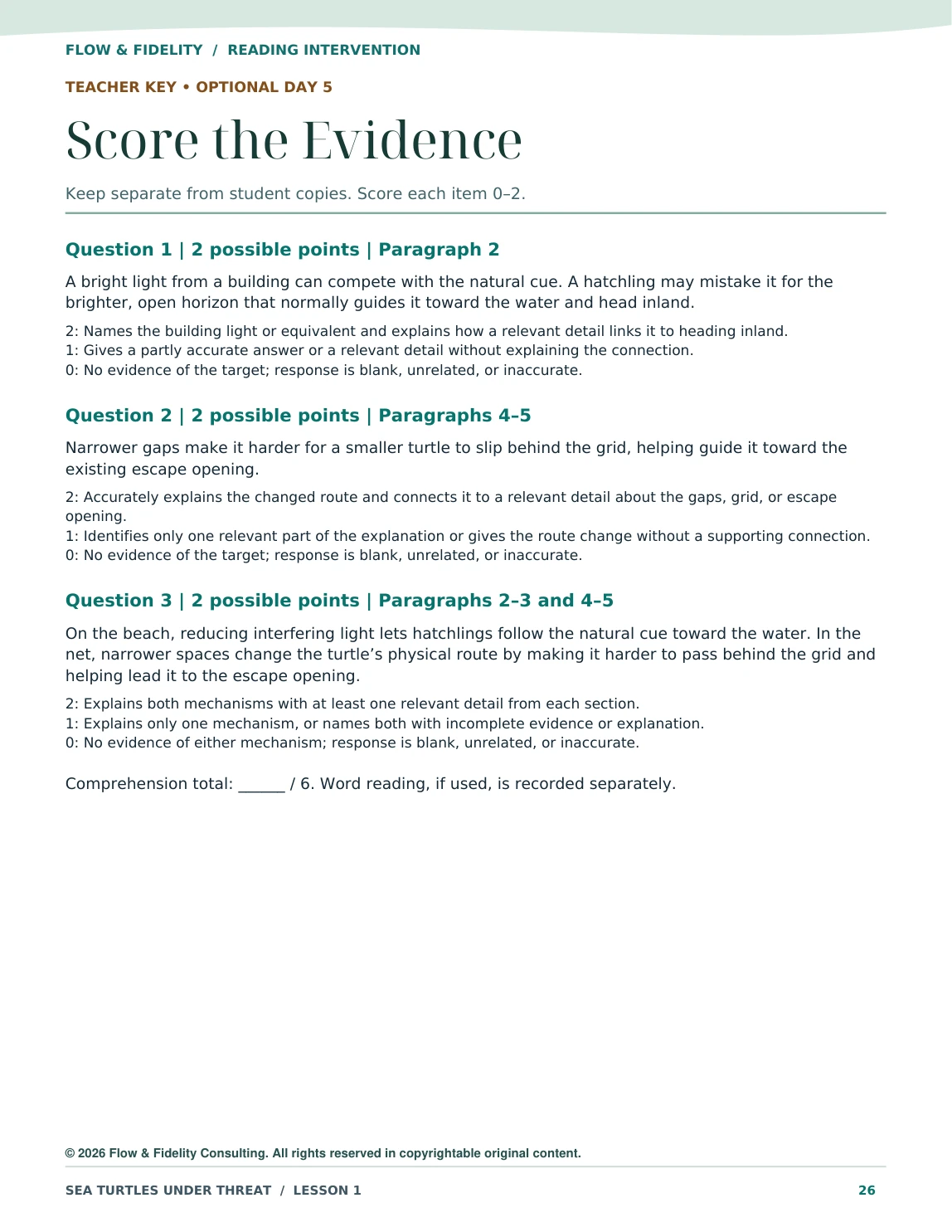
TEACHER KEY • OPTIONAL DAY 5


Score the Evidence
Keep separate from student copies. Score each item 0–2.


Question 1 | 2 possible points | Paragraph 2
A bright light from a building can compete with the natural cue. A hatchling may mistake it for the
brighter, open horizon that normally guides it toward the water and head inland.
2: Names the building light or equivalent and explains how a relevant detail links it to heading inland.
1: Gives a partly accurate answer or a relevant detail without explaining the connection.
0: No evidence of the target; response is blank, unrelated, or inaccurate.


Question 2 | 2 possible points | Paragraphs 4–5
Narrower gaps make it harder for a smaller turtle to slip behind the grid, helping guide it toward the
existing escape opening.
2: Accurately explains the changed route and connects it to a relevant detail about the gaps, grid, or escape
opening.
1: Identifies only one relevant part of the explanation or gives the route change without a supporting connection.
0: No evidence of the target; response is blank, unrelated, or inaccurate.


Question 3 | 2 possible points | Paragraphs 2–3 and 4–5
On the beach, reducing interfering light lets hatchlings follow the natural cue toward the water. In the
net, narrower spaces change the turtle’s physical route by making it harder to pass behind the grid and
helping lead it to the escape opening.
2: Explains both mechanisms with at least one relevant detail from each section.
1: Explains only one mechanism, or names both with incomplete evidence or explanation.
0: No evidence of either mechanism; response is blank, unrelated, or inaccurate.

Comprehension total: ______ / 6. Word reading, if used, is recorded separately.


SEA TURTLES UNDER THREAT / LESSON 1                                                                             26

© 2026 Flow & Fidelity Consulting. All rights reserved in copyrightable original content.